
ALL OUR BEST WISHES FOR THE NEW YEAR AND A HUGE THANK YOU FOR YOUR OUTSTANDING RESILIENCE!
R&D at Your Service — Staff (Dis) Satisfaction Survey: Key Findings and Analysis
Dear F4E’ colleagues,
Despite repeated attempts to reassure, minimise or relativise the situation, the dramatic results of the latest Staff (Dis)Satisfaction Survey once again confirm what you have been saying for years: the crisis at F4E is real, it persists, and it remains unresolved.
And you have even endured with great patience the presentation of these results and the painful and ridiculous attempts to deny their gravity, particularly the devastating judgement expressed on Senior Managers (lack of) leadership. Disastrous results — and results that are even more catastrophic concerning the leadership within the Director’s own department and the Project Department (see point 9.1 below)
Years of failure, systematically ignored survey findings, record-low levels of trust in senior management, inadequate protection of victims, endless internal investigations, and the persistent disregard for external findings narratives portraying F4E as an institutional paradise immune to criticism, attempts to dismiss staff concerns as exaggerated, isolated or statistically insignificant also when it comes to addressing the most tragic events, the deliberate attempt to disqualify the critical positions expressed by staff representation by branding them as a “common misconception”… cannot be compensated for by statements or promises, however carefully framed.
“If you always do what you’ve always done, you’ll get what you’ve always got, if you are not part of the solution, then you are part of the problem.”
Restoring trust and credibility requires leadership, accountability and effective governance, translated into concrete, measurable and verifiable actions. This is not a communication issue, but a governance and compliance issue.
What is at stake goes far beyond individual responsibilities. It concerns the institutional credibility of F4E, the credibility of the Commission, confidence in F4E’s ability to fulfil its mandate — notably regarding ITER — and its ambition to assume an expanded role within the EU Fusion Strategy.
Let us be clear: your messages must no longer go unanswered. Enough communication campaigns. Enough slogans. Enough commitments announced and never implemented.
Resilience has carried F4E staff a long way.
But resilience cannot replace leadership.
It cannot replace accountability.
And it cannot replace action.
The time for visible, concrete and structural change is long overdue.
That is why, for us today, this is not about ritual New Year’s wishes, nor about waiting yet again for long-standing promises to be fulfilled.
It is also about reaffirming and strengthening our collective commitment, as Federal R&D — the leading trade union of the European civil service — to stand alongside F4E’ staff in overcoming a crisis that has dragged on for far too long, and whose first and constant victims have been the staff.
But this message is also — and above all — about you.
It is about recognising your extraordinary resilience. A resilience forged through years of pressure, disappointment and adversity, and which has enabled you, time and again:
- · to resist those who hoped — and who still hope — that fatigue, discouragement or disillusionment would eventually silence you refusing the calls to remain silent “for the good of F4E” or “to protect its future”, when silence only deepens the crisis and prolongs suffering;
- · to reject pressure not to support demands for stronger governance from the Commission, under the misleading claim that this would place F4E “under supervision”, when in reality it is a precondition for restoring trust, credibility and accountability, given that F4E management has shown either a lack of willingness, or at the very least a lack of capacity, to resolve its crisis autonomously,
- · to oppose clumsy and unacceptable attempts to circumvent the application of the new Commission Decision on harassment and the mandate of the Chief Confidential Counsellor, by asking us to intervene directly with the Commission, demonstrating your commitment by participating massively in the webinars we organised on this matter expressing your sincere appreciation for the support obtained from Commissioner Serafin in response to our requests;
- · to continue, year after year, through the endless succession of consultations, root cause analyses, staff surveys, pulse surveys and “expression directe” exercises, to raise your voices, to express your discomfort, your loss of confidence in senior management, and your unwavering and unmistakable call for genuine change.
And despite everything, you have continued to stand firm. You have continued to speak. You have refused resignation.
Most recently, you did so once again by responding to the Staff (Dis)Satisfaction Survey.
R&D at Your Service — Staff (Dis)Satisfaction Survey: Key Findings and Analysis. read…
1. Participation Rate read…
2. Senior Management Leadership (Completely Disqualified) read…
3. Line Manager leadership fully recognised read...
4. Purpose, Values and Trust read…
5. Efficient Working Environment read…
6. Diversity, Equity & Inclusion read…
7. Wellbeing read…
8. Transparency read…
9. Departmental analysis – Cross-cutting findings read…
Conclusion read...
R&D at Your Service — Staff (Dis)Satisfaction Survey: Key Findings and Analysis
As always, and with the support of our specialised experts, we have carried out a thorough, independent and rigorous analysis of the newly published Staff (Dis)Satisfaction Survey results, which you will find below.
- 1. Participation Rate
Participation in the 2025 Staff Survey declined, with only 67% of staff taking part, representing a drop of 11 percentage points compared with 2022. However, a participation rate that remains significant, despite fatigue, discouragement and loss of trust.
In 2022, 78% of staff responded to the Staff Survey in the hope that it would lead to meaningful change. Unfortunately, this expectation was not met.
When asked whether they believed that the results of the survey would be taken into account in order to bring about improvements, this time only 32% responded positively — a decrease of 12 percentage points compared with 2022.
While we deeply value the resilience of those colleagues who refused to give up and continued to speak out, we also fully understand the exhaustion, frustration and despair of those who chose not to respond to the consultation.
Many have let us know to have reached the point of believing that, once again, their voices would be deliberately ignored, that yet another hollow and ineffective action plan would be rolled out for appearances’ sake, and that, in reality, nothing whatsoever would be done to address the findings or to act on the results. Or, worse still, that a witch-hunt could be launched in order to identify colleagues who dared to respond critically.
This loss of confidence is not indifference, it is the direct consequence of years of denial, inaction and broken promises.
- 2. Senior Management Leadership (Completely Disqualified)
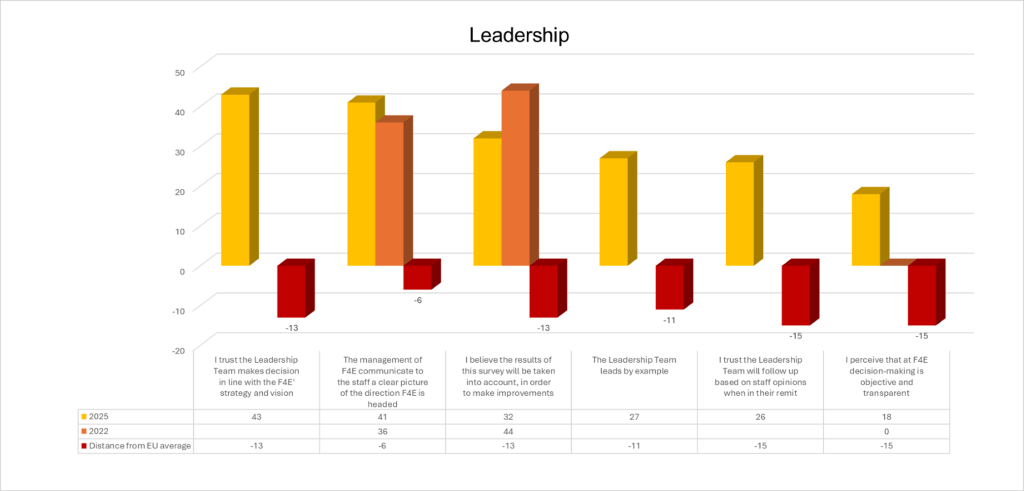
The results relating to Senior Management (lack of) leadership are not only worrying — they are alarming.
NONE of the leadership indicators reaches a 50% satisfaction rate, and ALL results are systematically below the EU average, revealing a profound and persistent lack of confidence in the F4E Leadership Team.
- · “The Leadership Team leads by example (i.e. their actions are consistent with their messages and with F4E’s activities)”: despite an already very low satisfaction rate in 2022 (27%), no progress whatsoever has been achieved in 2025. The gap with the EU average remains substantial at –11 percentage points, confirming staff perceptions that leadership behaviour does not align with declared values or priorities.
- · “I trust the Leadership Team will follow up on staff opinions when this falls within their remit”: here again, no improvement is observed. Satisfaction stagnates at 26%, with a widening gap of –15 percentage points compared with the EU average. This result clearly reflects a widespread belief that staff input is neither taken seriously nor acted upon.
- · “I trust the Leadership Team makes decisions in line with F4E’s strategy and vision”: with only 43% of respondents expressing confidence, this indicator points to a significant credibility gap (–13 percentage points compared with the EU average) between stated strategic objectives and actual decision-making.
- · “I perceive that decision-making at F4E is objective and transparent”: this is by far the most critical result. With a mere 18% satisfaction rate and a gap of –15 percentage points below the EU average, it highlights a deep-seated perception of opacity and arbitrariness in decision-making processes.
Taken together, these results send an unmistakable message: staff trust in F4E Leadership Team is at a very critically low level.
The absence of any tangible improvement since 2022, despite repeated survey feedback, raises serious questions about the willingness and capacity of the Leadership Team to acknowledge these concerns and to take the corrective action that staff clearly expect.
And this is, if anything, even more dramatic within the Director’s Department and the Project Department, reaching levels unprecedented in any European institution (see below under point 9.1), showing that there is no limit to the worst.
Leadership can function either as a risk factor or as a protective factor in the prevention of psychosocial risks.
In the present case, the results relating to F4E leadership clearly point to the existence of significant psychosocial risk factors.
In particular, only 18% of respondents consider that decision-making within the organisation is objective and transparent, a result that is especially concerning from a psychosocial risk prevention perspective.
Such results are indicative of a deterioration in social relations and a deficit in the quality of interactions between staff and the Leadership Team. These are well-established psychosocial risk factors which may generate pathogenic mechanisms such as feelings of professional devaluation, loss of meaning at work and relational insecurity. Over time, and if left unaddressed, these factors are likely to lead to adverse health outcomes, including chronic stress, burnout and, in some cases, situations of harassment.
From a prevention standpoint, these findings call for immediate and structured corrective measures, including a critical review of leadership practices, strengthened transparency in decision-making processes, and meaningful mechanisms to ensure that staff feedback is taken into account and followed up.
Even though credibility is fundamentally undermined when those claiming to offer solutions are, quite evidently, the very ones responsible for the problem they now pretend to resolve.
- 3. Line Manager leadership fully recognised
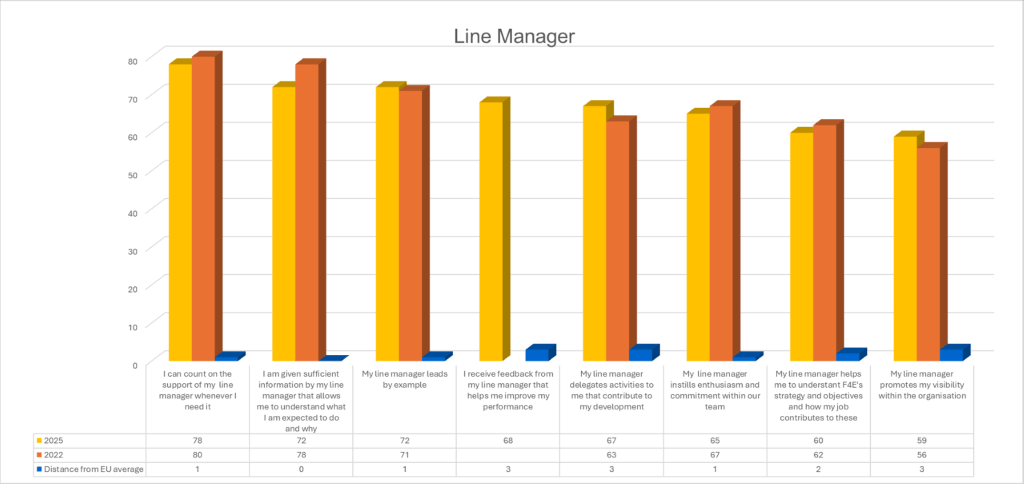
At the same time, the positive results relating to Line Managers — which are above the EU average — constitute an important protective factor.
They demonstrate that supportive management practices exist within the organisation and provide a solid basis on which to build a comprehensive psychosocial risk prevention strategy.
This once again confirms that F4E staff are perfectly capable of identifying and denouncing bad practices, and of clearly distinguishing them from good ones. It also shows that F4E continues to rely on an intermediate management layer which has, time and again, played the role of a last line of defence, protecting staff and the organisation from the even greater damage that a disastrous senior management leadership would otherwise have caused.
- 4. Purpose, Values and Trust
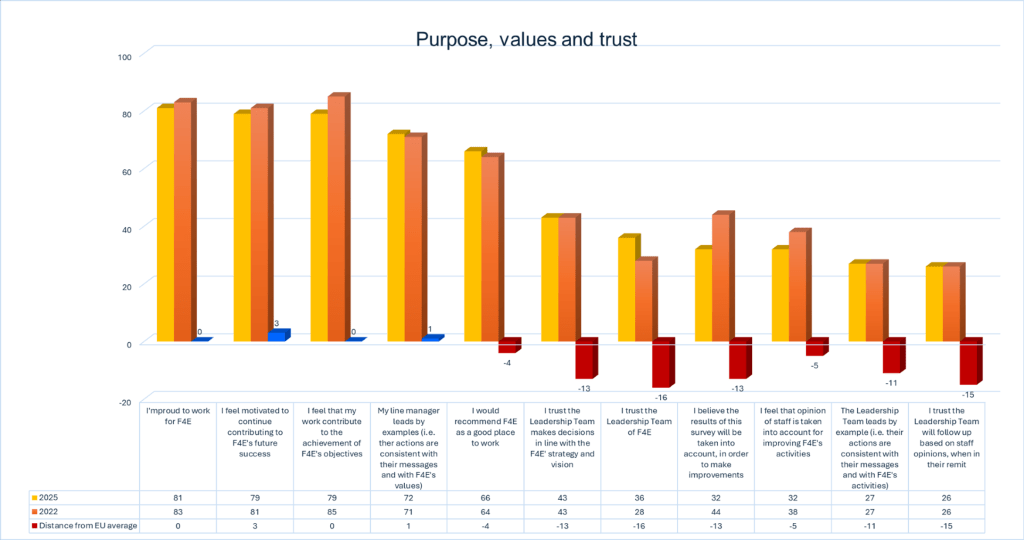
This profound disappointment is also reflected in the results relating to “Purpose, values and trust”, where an alarming gap emerges between the 2025 results and the EU average.
By way of example, in response to the statement “I trust the Leadership Team of F4E”, only 36% of respondents expressed a positive view, corresponding to a –16 percentage point gap compared with the EU average. Such a result points to a serious erosion of trust at organisational level.
From a psychosocial risk prevention perspective, this lack of trust constitutes a major risk factor, as it directly affects staff engagement, sense of purpose and psychological safety. If not addressed through concrete and credible corrective measures, it is likely to further exacerbate stress, disengagement and relational tensions within the organisation.
This dimension is closely linked to that of dramatic results concerning Senior Management Leadership.
When analysed together, these two dimensions lead to the same conclusion: F4E staff are exposed to a combination of challenging situations and significant psychosocial risk factors which inevitably affect their well-being at work and have a tangible impact on their physical and mental health.
From a prevention perspective, this convergence of results should be regarded as a clear warning signal, calling for targeted, timely and effective preventive measures.
- 5. Efficient Working Environment
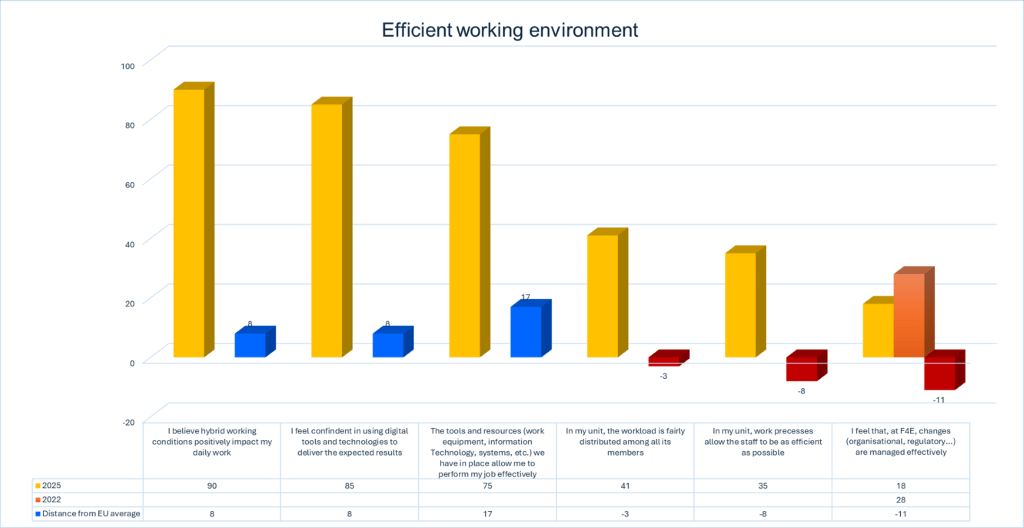
This dimension assesses the working environment, with a particular focus on hybrid working arrangements and workload.
The results show a very high level of satisfaction among F4E staff with the new hybrid working model. An overwhelming 90% of respondents consider that it has a positive impact on their daily work, as well as on the tools and technologies supporting it. This clearly constitutes a protective factor for staff well-being.
However, alongside this positive development, the survey also highlights several areas of concern related to change management, workload and work processes, which represent potential psychosocial risk factors:
- · “I feel that, at F4E, changes (organisational, regulatory, etc.) are managed effectively”: satisfaction has dropped sharply from 28% in 2022 to 18% in 2025, corresponding to a –11 percentage point gap compared to the EU average. This significant decline points to growing difficulties in coping with and making sense of change.
- · “In my unit, work processes allow staff to be as efficient as possible”: only 35% of respondents express satisfaction, with a –8 percentage point gap compared to the EU average, suggesting structural inefficiencies that may contribute to frustration and overload.
- · “In my unit, the workload is fairly distributed among all its members”: 41% of participants report satisfaction, which, although closer to the EU average, still reflects an uneven perception of workload allocation.
Taken together, these results indicate that while hybrid working is widely perceived as a success, shortcomings in change management, work organisation and workload distribution continue to undermine the quality of the working environment. From a psychosocial risk prevention perspective, these issues warrant targeted corrective measures to prevent the emergence or aggravation of stress-related risks.
In this dimension, we have identified three key areas requiring particular attention: workload, work processes and change management.
These three areas correspond to well-established psychosocial risk factors linked to work demands and organisational structure. They highlight a central issue repeatedly expressed by staff, namely the feeling of being hindered in the effective performance of their duties, as well as the presence of organisational constraints that are not aligned with — and, in some cases, incompatible with — the demands placed upon them.
From a psychosocial risk prevention perspective, such conditions significantly increase the risk of stress, disengagement and loss of meaning at work, and therefore call for targeted and timely corrective action.
- 6. Diversity, Equity & Inclusion
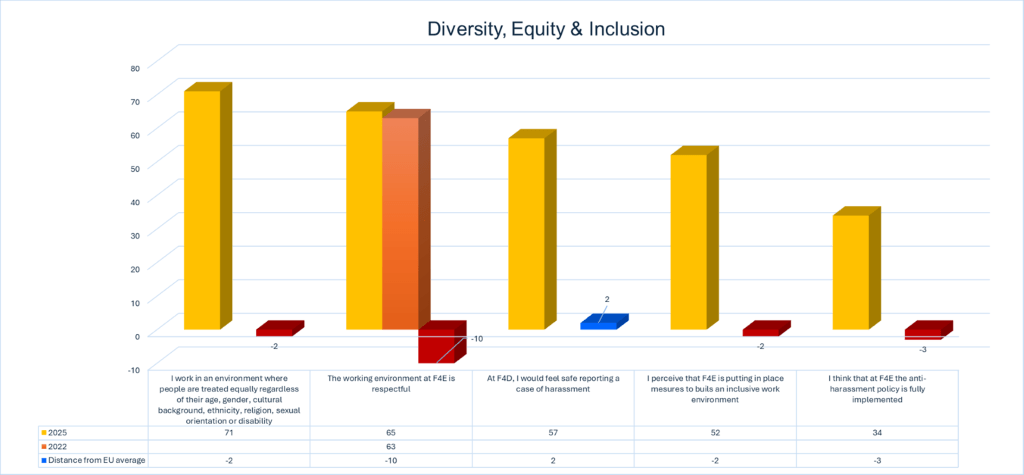
The results for this dimension are also highly concerning, in particular with regard to the implementation of the anti-harassment policy, where only 34% of respondents express satisfaction.
This despite F4E’s repeated claims that its procedures were exemplary, claims that led it to initially refuse the application of the new Commission Decision and the competence of the CCC.
These results once again confirm our serious concerns regarding the implementation of a genuinely effective anti-harassment policy. A satisfaction rate of only 34% among respondents clearly indicates an urgent need for substantial improvement. This is especially alarming given that an effective anti-harassment policy constitutes a cornerstone of staff well-being and psychosocial risk prevention.
Furthermore, the results for the “Diversity, Equity and Inclusion” dimension are significantly below the EU average, particularly with regard to the perception of a respectful working environment. This reinforces the diagnosis of a deteriorating social climate.
The survey also reveals a –10 percentage point gap compared to the EU average concerning the perception of a respectful working environment at F4E.
Taken together, these findings point to significant weaknesses in the practical application and perceived effectiveness of the existing safeguards, which may contribute to a climate of insecurity and reluctance to raise concerns. From a psychosocial risk prevention perspective, this situation requires urgent attention and concrete remedial measures.
It is important to note that we are, once again, confronted with psychosocial risk factors linked to social relations in the workplace, including feelings of insecurity and conflicts of values. Such factors are known to have serious consequences for staff, including isolation, self-censorship (no longer speaking up due to the perception that doing so is futile), and targeted disengagement.
From a psychosocial risk prevention perspective, these signals should be treated as critical warning signs, requiring immediate and coordinated action to restore a safe, respectful and inclusive working environment.
- 7. Wellbeing
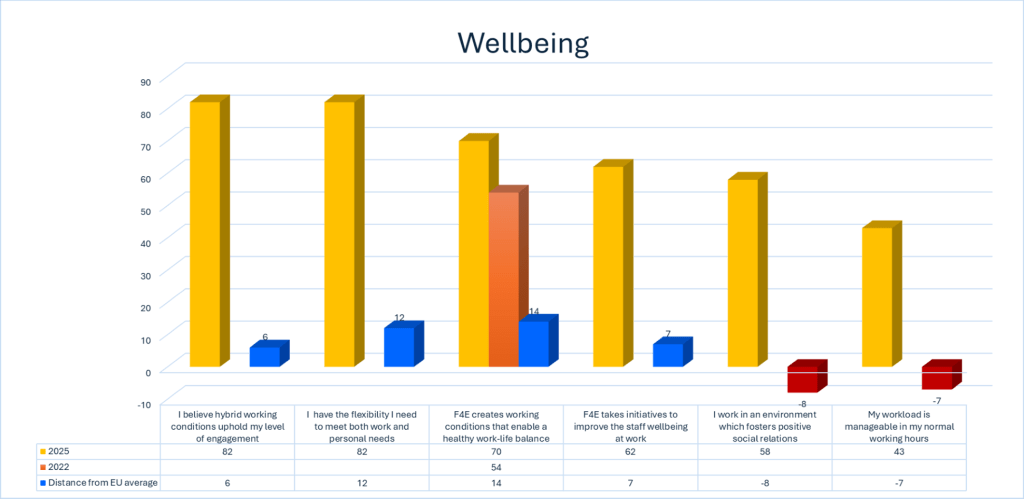
Staff well-being is a key prerequisite for enabling staff to perform their duties under optimal conditions.
The introduction of hybrid working has provided F4E staff with greater flexibility and has contributed positively to work–life balance. This represents an important protective factor for well-being.
However, significant challenges remain. Only 43% of respondents consider their workload to be manageable within normal working hours, corresponding to a –7 percentage point gap compared to the EU average. In addition, only 58% of respondents consider that they work in an environment that promotes positive social relations, which still represents a –8 percentage point gap compared to the EU average.
From a psychosocial risk prevention perspective, these results indicate that the positive effects of hybrid working are being undermined by persistent issues related to workload and the quality of social relations, which require targeted and sustained corrective action.
The Well-being dimension further highlights and confirms the pathogenic factors identified above, in particular those related to workload and social relations.
A workload that systematically requires overtime constitutes a significant psychosocial risk factor linked to the intensity and duration of work. Such a situation may result from an uneven distribution of workload, unrealistic performance expectations, or the progressive normalisation of overtime as a standard practice.
The consequences of this risk factor are well documented and include burnout, chronic fatigue and presenteeism, all of which have detrimental effects on both staff health and organisational performance.
- 8. Transparency
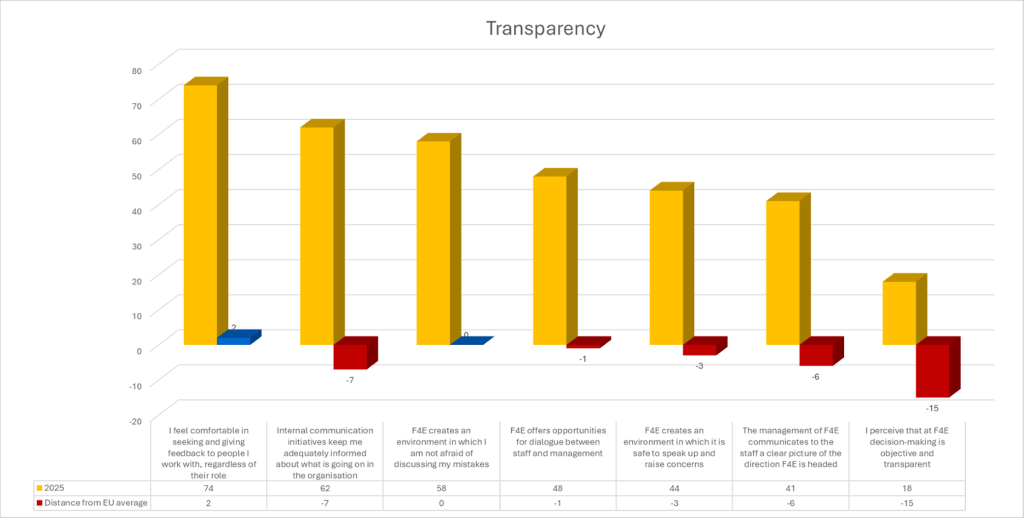
The results for this dimension are also highly concerning. Transparency is a key prerequisite for the smooth functioning of services and for maintaining trust within the organisation.
Only 18% of respondents perceive decision-making at F4E to be objective and transparent!
In addition, only 41% of respondents believe that F4E management communicates a clear and coherent picture of the direction the organisation is taking, representing a –6 percentage point gap compared to the EU average.
From a governance and psychosocial risk prevention perspective, these results point to serious shortcomings in transparency and communication, which are likely to fuel uncertainty, disengagement and mistrust among staff if not addressed through concrete and credible corrective measures.
- 9. Departmental analysis – Cross-cutting findings
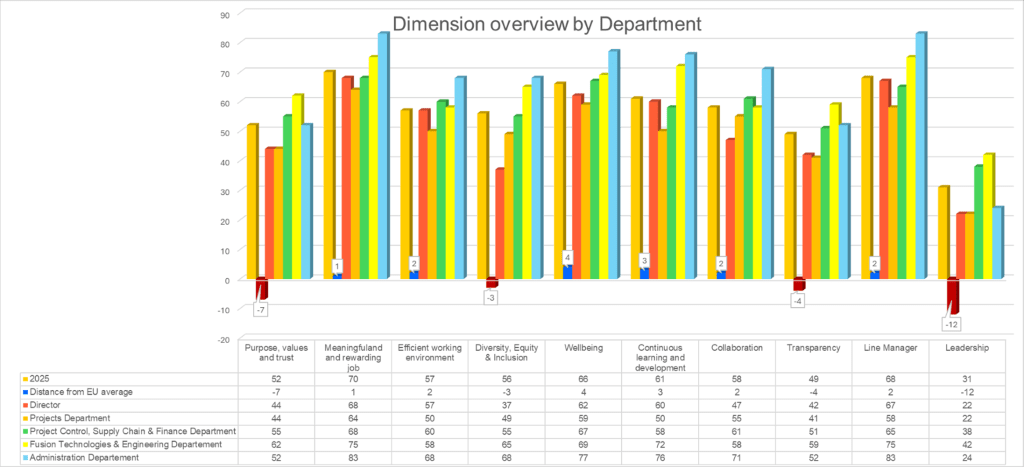
In response to the desperate, misleading and increasingly disheartening attempts to claim that problems are just structural and thus evenly distributed across F4E — a narrative that conveniently avoids establishing the responsibilities of individual senior managers — it must be stated clearly that such an approach is incompatible with any scientifically rigorous analysis of staff survey results.
On the contrary, it is imperative to conduct a detailed, service-by-service analysis of these results, precisely in order to draw targeted conclusions reflecting the specific nature of the difficulties observed, and, where justified, recognise genuine good practices.
Any attempt to dilute the findings through artificial averaging serves only to obscure accountability and perpetuate the very problems the organisation claims to address.
In this respect, when analysing the results by Department it appears that even they all show a negative gap compared to the EU average, however, they are not uniform across Departments.
The Director’s Department and the Project Department stand out as areas of very heightened concern.
- 9.1 Leadership: the absolutely disastrous results regarding leadership in the Director and Project Departments.
While the overall satisfaction rate for the Leadership dimension at F4E (31%) is already highly concerning, the situation is even more critical in these two departments…showing that at F4E there is not limit to the worst…
Indeed, the Director’s department and the Projects department have even more dramatic results in terms of leadership as in both case satisfaction drops to 22%, representing:
- · –9 percentage point gap compared to the F4E average, and
- · –21 percentage point gap compared to the EU average.
This speaks for itself. Under such circumstances, how can the leadership retain any legitimacy, let alone claim credibility with staff?
- 9.2 Purpose, values and trust
Again, neither the Director’s Department nor the Project Department reaches the 50% satisfaction threshold for this dimension. Both record a satisfaction rate of 44%, corresponding to:
- · –8 percentage point gap compared to the F4E average, and
- · –15 percentage point gap compared to the EU average.
- 9.3 Diversity, Equity and Inclusion : the results for the Director’s Department are particularly alarming!
With a satisfaction rate of only 37%, the Director’ Department scores:
- · –19 percentage points compared to the F4E average, and
- · –21 percentage points compared to the EU average.
These figures point to serious shortcomings in the perception of fairness, inclusion and respect within this Director’ Department.
- 9.4 Transparency
For the Transparency dimension, neither the Director’s Department (41%) nor the Project Department (42%) reaches the 50% satisfaction threshold.
Compared to the F4E average, this represents:
- · –7 percentage point gap for the Director’s Department, and
- · –8 percentage point gap for the Project Department, corresponding respectively to –11 and –12 percentage points below the EU average.
- Transversal conclusion
Taken together, these results reveal Department-specific concentrations of risk, particularly in areas directly linked to leadership, transparency, trust and inclusion.
From a psychosocial risk prevention perspective, the situation in the Director’s and Project Departments constitutes a priority area for targeted and immediate action, as the accumulation of negative gaps across multiple dimensions significantly increases the risk of stress, disengagement and deterioration of the working climate.
When analysed across dimensions, the survey results reveal a consistent and converging pattern pointing to structural weaknesses in leadership, governance and organisational communication, with direct consequences for staff well-being.
The very low levels of perceived transparency in decision-making (18% satisfaction) and the limited confidence in management’s ability to clearly communicate the organisation’s direction (41%, below the EU average) are not isolated findings. They are closely linked to the broader results on leadership, trust, social relations and well-being.
Taken together, these dimensions highlight a context in which uncertainty, lack of clarity and limited trust in decision-making processes constitute significant psychosocial risk factors. In such an environment, staff are more likely to experience feelings of insecurity, loss of meaning, disengagement and reduced psychological safety. These dynamics are further exacerbated by high workload, insufficiently managed change processes and persistent shortcomings in transparency and follow-up.
From a psychosocial risk prevention perspective, the convergence of these findings should be regarded as a systemic warning signal rather than as a collection of isolated issues. It indicates that the root causes of staff dissatisfaction and distress are embedded in organisational practices and governance mechanisms, rather than in individual situations.
Addressing these risks therefore requires coherent, cross-cutting corrective measures, including strengthened transparency in decision-making, clearer communication of strategic priorities, reinforced leadership accountability and meaningful involvement of staff in organisational change. Without such an integrated approach, there is a high risk that the negative impacts on staff well-being — including stress, burnout and disengagement — will persist or worsen over time.
Conclusion
Unfortunately, we can only observe that these our previous warnings ( link )
In our psychosocial risk report of January 2024, we had already drawn attention to the significant psychosocial risk factors to which F4E staff are exposed ( link ). These concerns were not theoretical; they were based on concrete indicators and staff feedback.
Moreover, the seriousness of the situation was finally confirmed by the results of the latest pulse survey ( link ), which highlighted that F4E staff continued to be exposed to:
- · interpersonal conflicts (77%),
- · psychological violence (9.9%),
- · sexual harassment (7.3%),
- · physical violence (4.7%).
The analysis of the most recent Staff Survey at F4E confirms that no tangible improvement has been achieved. On the contrary, the working environment and leadership remain a matter of serious and persistent concern.
In several critical areas, results have deteriorated significantly year after year, with a substantial and widening negative gap compared to the EU average, reaching particularly alarming levels within the Director’s department and the Project Department.
From a psychosocial risk prevention perspective, this lack of progress — despite repeated warnings, documented evidence and explicit acknowledgement at management level — raises serious doubts about the effectiveness and adequacy of the measures implemented to date.
It is not a matter of managerial goodwill, personal sensitivity or empathy, nor can it depend on the individual capacity or willingness of managers to recognise or understand underlying problems.
The protection of staff health and well-being is a clear, binding and non-negotiable legal obligation, fully covered by Directive 89/391/EEC. It cannot depend on managerial goodwill, communication strategies or individual sensitivity. Psychosocial risks must be identified, assessed and addressed in a systematic, effective and continuously adapted manner.
The Staff Survey results unequivocally demonstrate that, despite extensive communication efforts, repeated announcements and successive action plans, NO meaningful progress has been achieved.
Years of failure, systematically ignored survey findings, record-low levels of trust in senior management, inadequate protection of victims, endless internal investigations, and the persistent disregard for external findings cannot be compensated for by statements or promises, however carefully framed.
Restoring trust and credibility requires leadership, accountability and effective governance, translated into concrete, measurable and verifiable actions. This is not a communication issue, but a governance and compliance issue.
What is at stake goes far beyond individual responsibilities. It concerns the institutional credibility of F4E, the credibility of the Commission, confidence in F4E’s ability to fulfil its mandate — notably regarding ITER — and its ambition to assume an expanded role within the EU Fusion Strategy.
An organisation entrusted with such responsibilities must demonstrate exemplary governance without ambiguity.
Nothing less is acceptable.
Trust is not restored by tone. Trust is restored only through effective action and visible change.
Cristiano SEBASTIANI,
President