Staff Survey 2025
Staff engagement: Comprehensive analysis and R&D Recommendations
We have already noted with satisfaction that Commissioner Serafin has taken a clear and explicit political stance by stating:
“The Staff Survey is the Commission’s most important listening exercise, giving us the broadest possible picture of what we are doing well and where we need to improve. The results confirm that our people remain highly engaged and committed – a real strength for the institution. At the same time, the clear call for change, with 77% of staff saying we need to adapt how we work to remain relevant and effective, underlines the importance of our ongoing large-scale review, which is precisely about making the Commission stronger, more responsive, more effective, and ready for what lies ahead.”
We have already welcomed, and warmly thanked, Commissioner Serafin for his commitment to what is presented as a major exercise in listening to staff.
We have also underlined that Commissioner Serafin’s commitments cannot, under any circumstances, remain purely declaratory and must be followed by concrete, visible and verifiable action.
Any failure to do so would render these commitments meaningless and would further erode staff trust.
Therefore, we are confident that, in keeping with his commitment to ensuring the greatest transparency, Commissioner Serafin will give a favourable response to our request to publish detailed results at the level of Directorates and other entities of sufficient size to avoid any risk of identifying the colleagues concerned.
This full transparency is indeed essential to better identify situations within DGs and address them and not least because it is supposed to inform and guide the work and conclusions of the Large-Scale Review…
Executive Summary
The Staff Survey is one of the tools used to listen to staff.
The engagement index is a key metric in evaluating the main protective and risk factors, with the aim of preventing occupational risks, particularly psychosocial ones.
The 2025 exercise is being conducted alongside the Large-Scale Review. The objective of this exercise is to enhance the institution’s effectiveness, attractiveness and ability to adapt to global challenges.
The results are positive overall, but there are indications of a slowdown
Since 2016, the engagement index has increased steadily, reflecting an overall improvement in the working environment within the Commission. However, the 2025 results show a slowdown in this trend, with several key indicators declining.
While overall engagement remains high, certain trends indicate emerging weaknesses regarding:
- The perception of the quality of teamwork;
- The clarity of professional expectations;
- The importance of feeling listened to and considered in decision-making processes cannot be overstated.
These results indicate potential issues that require careful consideration within the context of the Large Scale Review.
Contrasting situations across directorates-general
The analysis highlights a growing divergence between directorates general.
- 1. DGs/EAs/Offices in decline
The 14 DGs in decline exhibit a combination of unfavourable factors relating to recognition, participation, managerial support and organisational clarity.
The situations in TAXUD and INTPA particularly illustrate the consequences that can result, respectively, from a gradual deterioration in the organisational climate and the impact of a major reorganisation on staff’s sense of security.
- 2. DGs/EAs/Offices showing improvement
The 25 DGs showing improvement are mainly characterised by better management practices, greater recognition of staff work and increased support for skills development.
- 3. Stable DGs/EAs/Offices
DGs whose results are stagnating generally maintain a satisfactory level of engagement but present several areas for concern, particularly regarding staff participation and collective cohesion.
The crucial role of Middle Management
Analysis of the engagement index highlights the central role played by middle management.
The results demonstrate that the departments which have shown the most improvement are also those where staff members perceive:
- stronger managerial support;
- greater recognition of the work accomplished;
- more sustained support for professional development.
Middle management has been identified as a significant protective factor against psychosocial risks. It has been shown to contribute to the enhancement of psychological safety, organisational trust, engagement and teams’ ability to cope with change.
This regulatory function now appears to be one of the institution’s main drivers of resilience.
Professional development: a key protective factor
Among the seven dimensions analysed, support for skills development is the only factor showing a positive trend across all categories of senior management, whether they are improving, stable or declining.
This trend reflects a growing willingness among managers to support career paths and prepare their teams for future changes, particularly in a context marked by digital transformation, artificial intelligence and evolving skill requirements.
Although satisfaction levels remain modest in some cases, this improvement is an encouraging sign for the future.
Three major weaknesses emerge
- 1. A decline in the sense of being heard
The observed decline in responses to the question “I feel that my opinion is valued” appears to be one of the most worrying findings.
This trend reflects a weakening of staff members’ sense of involvement and recognition in decisions that affect them. It may undermine trust in the organisation, reduce engagement and stifle innovation as well as collective intelligence.
- 2. The gradual weakening of the work collective
The decline observed in the perception of colleagues’ engagement is also a sign to watch.
Although satisfaction levels remain high, this trend may reflect:
- · an increase in workload;
- · imbalances in the distribution of tasks;
- · a gradual erosion of trust between colleagues;
- · a heightened perception of organisational injustice.
In the medium term, this development could affect team cooperation and cohesion and give rise to psychosocial risks such as conflicts between colleagues, harassment, burnout, silent disengagement…
- 3. The weakening of organisational clarity
In several DGs where satisfaction is declining, staff report greater difficulty in understanding their organisation’s priorities, objectives or expectations.
Vague expectations can lead to demotivation, a sense of organisational injustice, staff disengagement, tensions… which may result in a breakdown of the psychological contract between staff, their department and the institution.
Conclusion
The analysis highlights an institution whose foundations remain solid, but which is entering a transitional phase requiring increased attention.
The results confirm that middle management is now one of the main drivers of organisational stability, psychosocial support and skills development.
At the same time, several early warning signs are emerging regarding staff engagement, team cohesion and organisational clarity. Should these trends continue, they could gradually affect staff engagement as well as exposure to psychosocial risks.
R&D recommends preserving the human dimension of work during the Large-Scale Review, in order to ensure the organisation’s sustainable performance and staff well-being.
10 R&D recommendations
- 1) Establish a tailored occupational risk-prevention policy for each DG to strengthen engagement and well-being and limit psychosocial risks, including those linked to new technologies and work methods.
- 2) Consolidate the protective role of middle management.
- 3) Strengthen recognition and valorisation of work.
- 4) Enhance organisational communication with Senior Management and the College.
- 5) Clarify priorities and expectations.
- 6) Align objectives with the resources provided, including at the workstation level.
- 7) Support change during the Large-Scale Review, based on needs analyses by DG and by directorate.
- 8) Safeguard long-term organisational sustainability, notably by ensuring optimal working conditions through workload management
- 9) Support the corporate culture and its values.
- 10) Put the HUMAN dimension back at the heart of the institution.
- I have the appropriate and timely information I need to do my work well
- My colleagues are committed to doing quality work
- I have a clear understanding of what is expected of me at work
- I regularly receive recognition or compliments for my work
- I feel that my opinion is valued
- My manager cares about me as a person
- My manager helps me identify my learning and development needs
II. Analysis of Staff Engagement
Since 2016, we have generally seen a gradual evolution of this index, 9 more points despite stagnation between 2023 and 2025...
II.1 DGs/EAs/OFFICES in decline
We have observed a decrease in the satisfaction rate for 16 DGs/EAs/Offices: CAB, CNECT, EAC, ENV, ESTAT, FISMA, GROW, HOME, IAS, INTPA, MOVE, REGIO, REGIO.EMPL.DAC, SRD/MOVE/ENER, TAXUD and TRADE.
By comparing the results of these DGs, we find:
- Three very high-risk factors
- Three risk factors to be monitored
- One protective factor
II.2 Developing DGs/EAs/OFFICES
25 DGs/EAs/Offices have progressed*: CINEA, CLIMA, COMP, DEFIS, DGT, DIGIT, EACEA, ECFIN, ECHO, EISMEA, EMPL, ENER, EPSO, FPI, HADEA, HERA, JRC, JUST, MARE, OIB, PMO, REA, RTD, SCIC, and SJ.
By comparing the results of these DGs, we found that:
- Five protective factor
- Two factors to be monitored
II.3) DGs/EAs/Offices stagnation
We also note stagnation for 13 DGs/EAs/Offices: AGRI, BUDG, COM/SPP/REP, ENEST, ERCEA, HR, MENA, OIL, OLAF, OP, SANTE, SG and SG REFORM.
By comparing the results of these DGs, we found that:
- Four protective factor
- Two factors to be monitored
- One high risk factor
The Staff Engagement Index highlights protective factors, factors to monitor, and risk factors across DG group results, whether they have declined, improved or remained stable.
Introduction
We have already noted with satisfaction that Commissioner Serafin has taken a clear and explicit political stance by stating:
“The Staff Survey is the Commission’s most important listening exercise, giving us the broadest possible picture of what we are doing well and where we need to improve. The results confirm that our people remain highly engaged and committed – a real strength for the institution. At the same time, the clear call for change, with 77% of staff saying we need to adapt how we work to remain relevant and effective, underlines the importance of our ongoing large-scale review, which is precisely about making the Commission stronger, more responsive, more effective, and ready for what lies ahead.”
We have already welcomed, and warmly thanked, Commissioner Serafin for his commitment to what is presented as a major exercise in listening to staff.
We have also underlined that Commissioner Serafin’s commitments cannot, under any circumstances, remain purely declaratory and must be followed by concrete, visible and verifiable action.
Any failure to do so would render these commitments meaningless and would further erode staff trust.
Therefore, we are confident that, in keeping with his commitment to ensuring the greatest transparency, Commissioner Serafin will give a favourable response to our request to publish detailed results at the level of Directorates and other entities of sufficient size to avoid any risk of identifying the colleagues concerned.
This full transparency is indeed essential to better identify situations within DGs and address them and not least because it is supposed to inform and guide the work and conclusions of the Large-Scale Review.
R&D Federal, mindful of its responsibilities as the leading trade union of the European civil service, has established at central level a multidisciplinary team composed of legal experts, labour inspectors, and lawyers specialising in occupational risk prevention, to ensure that every analysis we publish is fair and well-founded.
True to our commitment never to confine ourselves to merely issuing demands or to adopting banal, simplistic positions, following an initial communication we are today presenting the first of our in-depth analyses of the Staff Survey results. This is also intended to help colleagues within the DGs prepare well-targeted, effective action plans that reflect best practice and the insights of subject-matter experts.
Indeed, the Staff Survey is an essential tool for measuring staff satisfaction. Most questions are drawn from scientifically validated questionnaires, each designed to assess protective or risk factors in specific areas.
At R&D, we have worked to ensure this tool is recognised and taken seriously by the administration—without it becoming a mere formality.
Scientific research continues to advance in response to the evolving demands of the modern workplace. As a social partner, R&D invests in and participates in academic and scientific events to stay abreast of the latest social science research—some not yet published—so we can analyse workplace transformations within our institution and its departments, provide reliable and robust contributions, and make informed recommendations.
The world of work is changing, and R&D has chosen to be an active player in this evolution within the European institutions by identifying emerging challenges that differ from those of the past. The difficulties observed over the last decade are only the visible part of the iceberg, particularly with the introduction of new technologies and AI.
Globally, businesses and administrations are preparing for these shifts—as is our institution, through the Large-Scale Review exercise aimed at becoming more attractive, more effective, and better positioned to respond to European and global challenges, all within a budget smaller than those of large national administrations.
To succeed in this wide-ranging exercise, it is essential to lay solid foundations: to stay close to staff, to use our voice, and to ensure that what emerges from the Staff Survey is heard at the highest level. Above all, we must safeguard the welfare and health of both staff and the institution.
We have worked extensively to produce this first deep analysis of “Staff Engagement”
Further analyses will follow—covering management, well-being at work, occupational futures, and more.
Each will be accompanied by recommendations that we will advocate for inclusion to be taken into account by the relative DG.
Now more than ever, R&D stands at the front line of this transition, supported by its experts and academic partners.
In order to be able to compare the previous financial years, we relied on the results of the old engagement index.
The engagement index was calculated according to seven questions:
- 1. I have the appropriate and timely information to do my work well
- 2. My colleagues are contracted to do quality work
- 3. I have clear understanding of what is expected from me at work
- 4. I receive regular recognition or Praise for good work
- 5. I feel that my opinion is matched
- 6. My manager cares about me as a person
- 7. My manager helps me to identify my learning and development needs
These questions make it possible to measure several factors, whether they are at risk or protective, such as:
- · Social and labour relations
- · Labour requirements: clarity of roles and objectives
- · Management
- · Recognition
- · Work organisation
- · The quality of the informal and formal information system
- · Development of powers
I. Defining factors
- 1. « I have the appropriate and timely information I need to do my work well »
This question concerns work requirements related to the means and availability of resources, particularly the quality of formal and informal information systems, as well as the maturity of the organisation and its management practices, including transparency, prioritisation and information sharing. These elements enable staff to carry out their work under the best possible conditions.
As a protective factor, this improves efficiency and coordination, while reducing stress and conflict.
As a risk factor, insufficient or poorly timed information increases stress linked to uncertainty, cognitive overload, errors, inconsistent decisions and tensions between colleagues.
- 2. « My colleagues are committed to doing quality work »
This question concerns social and labour relations, particularly the perception of collective commitment, quality of work and the reliability of colleagues. It also relates to the meaning of work, recognition and organisational justice. This also supports a perception of fairness, as others contribute to the work, and reduces the perception of opportunistic behaviour. It also provides a clearer picture of the quality of the working group and the level of trust among peers.
This factor is an indicator of horizontal trust and organisational cohesion.
As a protective factor, it fosters trust, mutual support, team cohesion, motivation, pride in one’s work and quality of service, thereby contributing to a strong institutional image.
As a risk factor, it may indicate excessive workload, loss of motivation linked to having to compensate for others, frustration, a sense of injustice, tensions and reduced cooperation between colleagues. These dynamics may affect the functioning of the service, leading to a decline in collective quality standards and the gradual disengagement of the team.
- 3. « I have a clear understanding of what is expected of me at work »
This question concerns work requirements, particularly the clarity of roles and objectives. It also provides insight into the understanding of priorities, the stability of policy guidelines, work organisation and governance in relation to structural factors. Management plays an essential role in defining and prioritising objectives.
As a protective factor, it gives staff a sense of control over their role in the process, which positively supports engagement, efficiency and cognitive security. It also enables coordination, greater autonomy, a climate of trust and strategic alignment with the institution’s policies.
As a risk factor, unclear expectations may lead to demotivation, a sense of organisational injustice, staff disengagement, tensions, inequalities and loss of performance, potentially resulting in a breakdown of the psychological contract between staff, their department and the institution.
- 4. “I regularly receive recognition or compliments for my work“
This question is a direct indicator of proximity management; it focuses on recognition of work, particularly support from Middle managers, which helps to assess the quality of day-to-day relationships with Middle managers as well as the ability to highlight the work accomplished.
As a protective factor, this helps to strengthen staff motivation, commitment and satisfaction, as well as mutual support and team spirit.
As a risk factor, this indicates a lack of motivation, a sense of organisational injustice, a disengagement among staff, as well as tensions, inequalities and a decline in performance, which may lead to a breakdown in the psychological contract between staff, their service and the institution.
- 5. « I feel that my opinion is valued »
This question concerns social relations and recognition at work, particularly the consideration given to individuals and the role they are given within their service and the institution. It pays particular attention to staff involvement, autonomy, and management practices in terms of listening and leadership.
As a protective factor, it increases staff engagement and motivation, while fostering collective intelligence and innovation by strengthening staff confidence in the institution.
As a risk factor, a lack of consideration may lead to a reduction in staff contribution and to silent disengagement.
- 6. « My manager cares about me as a person »
This question concerns social relations at work, particularly the quality of social support provided by managers to their staff, as well as the human dimension of managerial practices. In this context, R&D organised a conference on humane management with Laurent Taskin ( video link ).
This question addresses recognition of the individual as a person and the need for human dignity at work.
This is considered one of the major protective factors within any organisation, as it helps reduce stress and tensions. It is also a safeguard for psychological safety. The manager therefore acts as an organisational buffer. This is reflected in the results concerning middle management, which I will address in a forthcoming communication.
As a risk factor, a lack of managerial care may aggravate feelings of isolation, stress, lack of support, tensions, loss of trust and reduced performance. It may also have health consequences, such as stress, anxiety and burnout, particularly when combined with excessive workload .
- 7. « My manager helps me identify my learning and development needs »
This question concerns skills development and the support provided by the manager. It also relates to the manager’s ability to look ahead, support staff development and anticipate skills needs within the department. This managerial maturity is particularly valuable in a constantly changing world, as it helps staff align with the institution’s internal and overall requirements. The manager thereby recognises the work and skills of staff, which helps reassure them regarding their employment and future.
As a protective factor, it enables staff to be more engaged, progress in their careers and develop psychological trust and safety in relation to both their manager and the institution. This psychological safety supports better adaptation to change and greater agility.
As a risk factor, staff may feel demotivated and anxious, with limited opportunities to develop their skills and greater difficulty adapting to change. The institution may, in turn, face a loss of talent.
II. Analysis of Staff Engagement
Since 2016, we have generally seen a gradual evolution of this index, 9 more points despite stagnation between 2023 and 2025.
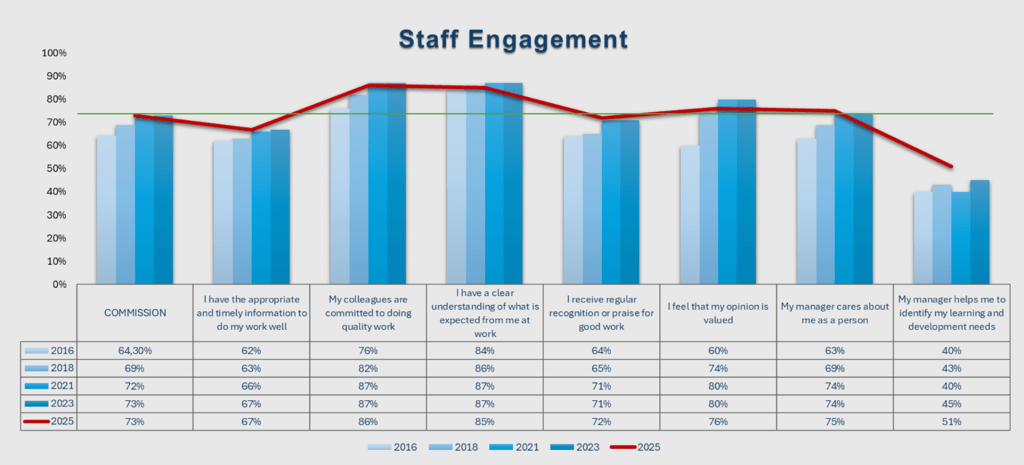
However, we see a slight fall in satisfaction, from -1 to -4 points, for three questions:
- My colleagues are committed to doing quality work
- I have clear understanding of what is expected from me at work
- I feel that my opinion is valued
In order to obtain a clearer picture of the situation within the institution’s services, we analysed the results per DG from three angles:
- · The DGs have progressed,
- · The DGs that have fallen and
- · DGs that have not evolved.
II.1 DGs/EAs/OFFICES in decline
We have observed a decrease in the satisfaction rate for 16 DGs/EAs/Offices: CAB, CNECT, EAC, ENV, ESTAT, FISMA, GROW, HOME, IAS, INTPA, MOVE, REGIO, REGIO.EMPL.DAC, SRD/MOVE/ENER, TAXUD and TRADE.
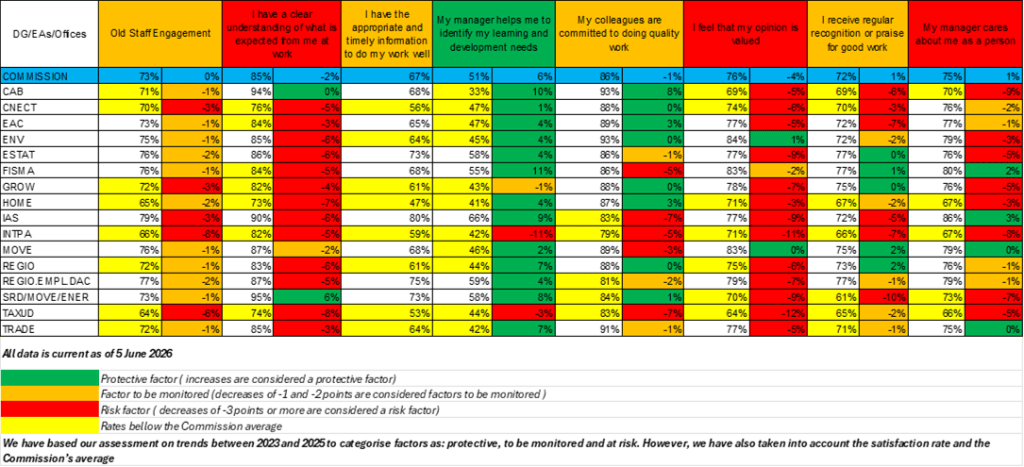
By comparing the results of these DGs, we find:
1) Three very high-risk factors
- · Working requirements, clarity of roles, objectives and priorities (For more information on this dimension, please refer to the feature: I have a clear understanding of what is expected from me at work).
We note a decline in satisfaction for 14 DGs/EAs/Offices: TAXUD: -8 points, HOME: -7 points; ENV, ESTAT, IAS, REGIO: -6 points; CNECT, FISMA, INTPA, REGIO.EMPL.DAC: -5 points; GROW: -4 points EAC, TRADE: -3 points…
The decline in satisfaction levels, despite the high rate, indicates a need for monitoring of professional expectations, as outlined in scientific literature. This decline may indicate a weakening of organisational standards and an increase in uncertainty in daily work. If not properly addressed, this risk factor has the potential to increase the mental and cognitive burden, which could in turn have a negative impact on the well-being of staff.
- · Social relations and recognition of work (For more information on this dimension, please refer to the feature: I feel that my opinion is valued)
We have observed a decrease in satisfaction for 14 DGs/EAs/Offices: TAXUD: -12 points; INTPA: -11 points; ESTAT, IAS, SRD.MOVE.ENER..: -9 points; GROW, REGIO.EMPL.DAC: -7 points; CNECT, REGIO: -6 points; CAB, EAC, TRADE: -5 points; HOME -3 points…
This factor is linked to recognition and organisational justice, particularly in relation to interpersonal dynamics, decision-making processes, and the place given to individuals within the collective functioning of the organisation.
Although the overall levels remain above 60%, the significant decrease observed in these DGs is a strong signal to be taken seriously and acted upon. This is particularly relevant in cases where individuals feel unheard or disregarded, whether by the service, the DG, or the institution as a whole.
This perception can have a significant impact on various aspects of the workplace, including psychological safety, collective engagement, the sense of belonging, and staff confidence in the institution and its decision-making processes.
- · Social relations at work, particularly the quality of the social support provided by managers to their staff and the consideration of “HUMAIN” in managerial practices (For more information on this dimension, please refer to the feature : My manager cares about me as a person). This indicator enables the measurement of the social and personal climate, as well as psychological safety.
We have observed a decrease for 12 DGs: CAB: -9 points; INTPA: -8 points; SRD.MOVE.ENER..: -7 points ; ESTAT, GROW, TAXUD: -5 points ; ENV, HOME: -3 points…
Although satisfaction levels remain above 66%, the decreases observed require vigilance.
The role of middle management, as a protective factor, will be essential in implementing the process within the services and supporting the psychological safety of teams.
This factor suggests that middle management has so far acted as a buffer between senior management and staff. However, despite its continued commitment and goodwill, it is beginning to show signs of fatigue.
2) Three risk factors to be monitored
- · Workplace requirements relating to resources and their availability (For more information on this dimension, please refer to the feature: I have the appropriate and timely information I need to do my work well)
That factor makes it possible to measure the quality of the information intended for staff and also makes it possible to measure the functioning of the organisation as a whole.
According to scientific literature, access to information transmitted in good time is an essential resource for staff so that they can meet professional requirements.
- · Social and labour relations, particularly the perception of collective engagement, the quality of work and the reliability of colleagues (For more information on this dimension, please refer to the feature: My colleagues are committed to doing quality work)
We have observed a decrease for 8 DGs: IAS, TAXUD: -7 points; FISMA, INTPA: -5 points; MOVE: -3 points…
We find an increase of 8 points for CAB; 3 points for EAC, HOME…
This factor is linked to horizontal social support, namely collective commitment.
When it decreases, staff may experience reduced support from colleagues and a perception of unfair workload distribution, which may lead to interpersonal tensions and organisational fatigue.
Social support between colleagues is a protective factor that helps staff cope with professional constraints and support one another.
If the decline continues in these DGs, cooperation and the social climate may be affected. This could lead to organisational disengagement and the emergence of presenteeism.
If this factor continues to decline, there is a risk of conflicts between colleagues, harassment and burnout.
- · Recognition of work, direct marker of proximity management (For more information on this dimension, please refer to the feature: I receive regular recognition or Praise for good work)
We have observed a decrease for 11 DGs/EAs/Offices: SRD.MOVE.ENER: -10 points ; INTPA, EAC: -7 points; CAB: -6 points; IAS: -5 points ; CNECT: -3 points…
Although the levels of satisfaction remain above 60%, the decreases observed are a signal to be monitored.
Recognition must be regarded as an inherent protective factor at work, supporting commitment and the ability to adapt to work requirements. It is directly linked to local management and may also provide important information on the state and situation of management and work organisation.
This factor should be monitored in these 11 DGs, most of which also show a decrease in satisfaction rates for the questions: “I feel that my opinion is valued” and “My manager cares about me as a person”.
The decline in satisfaction across these three questions raises concerns about possible managerial fatigue, work intensification, operational performance and/or a weakening of the human dimension in work related relations.
If this decline persists, staff motivation, team dynamics and well-being may be affected.
3) One protective factor
- · The development of skills and the manager’s ability to switch to the future (For more information on this dimension, please refer to the feature: My manager helps me to identify my learning and development needs)
We find an increase for 13 DGs: FISMA: + 11 points; CAB: + 10 points; IAS: + 9 points; SRD.MOVE.ENER: + 8 points; TRADE: + 7 points; EAC, ENV, ESTAT, HOME, REGIO.EMPL.DAC: + 4 points…
However, we see a decrease of 11 points for INTPA; 3 points for TAXUD…
That factor makes it possible to measure a number of dimensions such as professional development, managerial support, skills management, recognition of the potential of staff and the perception of the institution’s investment in its staff. It could become an attractive factor for the institution.
Although we find a positive development, the level of satisfaction remains low for some DGs below 50 % satisfaction (CAB, CNECT, EAC, ENV, GROW, HOME, INTPA, MOVE, REGIO, TAXUD, TRADE).
Support for professional development is an important factor in the recognition, support of his manager and development within the institution.
Those encouraging signs must continue and enable staff to evolve in their professional career.
· The TAXUD case
The satisfaction index stands at 64% and has fallen by 6 points, following a decline of 5 points in 2023.
The decline observed since 2021 can be attributed to a drop in satisfaction across all dimensions, particularly in the following areas:
- · I have a clear understanding of what is expected from me at work: – 10 points in 2021; -5 points in 2023 and -8 points in 2025
- · I feel that my opinion is valued: -8 points in 2023 and -12 points in 2025
- · I receive regular recognition or Praise for good work: – 13 points in 2023 and -2 points in 2025
- · My manager cares about me as a person: -5 points in 2023 and –5 in 2025
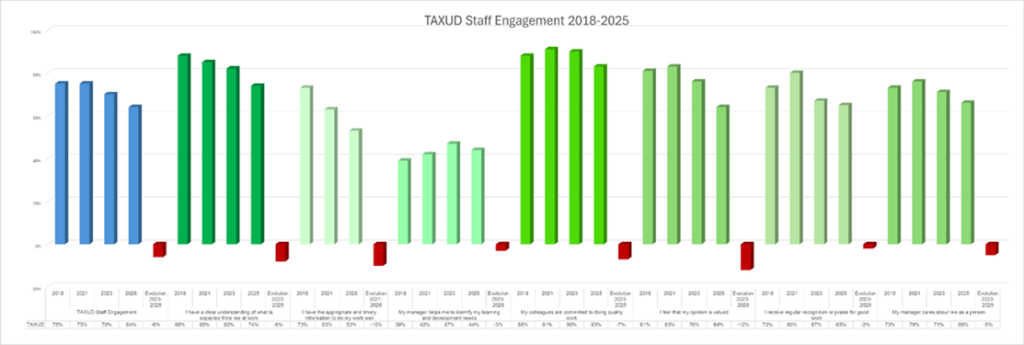
The evolution of the Staff Engagement Index shows a structural deterioration in the organisational climate within TAXUD and this is not due to a decrease in staff since the DG increased by 43 staff members.
The difficulties faced by TAXUD are the result of a lack of recognition and consideration of staff, devaluation of the work done and poor flow of information.
Those results show that Middle management is under tension.
In the absence of a robust action plan including targeted corrective measures, TAXUD will face a deterioration of the social climate, an increase in psychosocial risks and a collective decrease in engagement.
It can already be seen that organisational trust is breaking and that it is about to be broken and the psychological contract between staff and its DG.
· The DG INTPA case
The case of DG INTPA is quite different as DG INTPA faced with an announced deep reorganisation and a quite drastic cut of posts
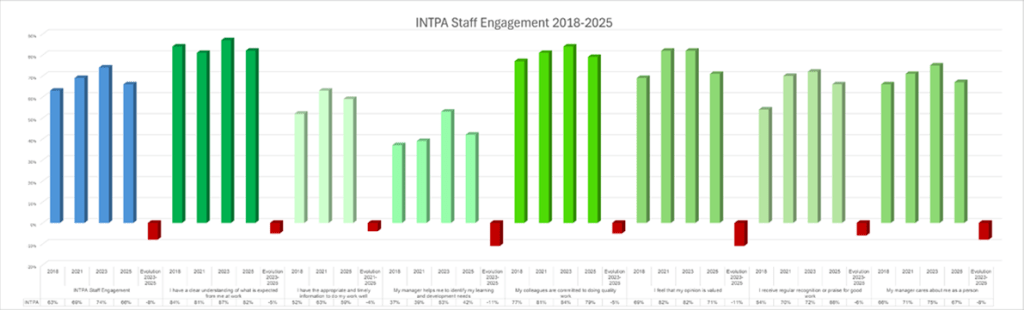
The satisfaction index stands at 66% and has fallen by 8 points whereas that DG has gradually evolved since 2018 from 63 to 74 % satisfaction between 2018 and 2023 with marked increases from 1 to 14 points for all questions.
However, in 2025 we see a decline in all questions from -5 to -11 points, in particular:
- · My manager helps me to identify my learning and development needs (42 % and -11 points)
- · I feel that my opinion is valued (71 % and -11 points)
- · My manager cares about me as a person ( 67% and -8 points)
Between 2025 and 2026 INTPA lost 145 staff, including 61 AC, 43 AL, 22 AD and 20 AST.
In 2023, INTPA was one of the DGs with the very high satisfaction rate of 74 % and an increase of 11 points compared to 2018.
There was also a considerable increase in all questions for calculating the commitment index.
That trend was confirmed in 2021.
It was not until 2025 that the decrease was noted
In 2025, INTPA was confronted with a press announcement of a far‑reaching reorganisation presented as a “modernisation of the EU Delegations.”
This announcement triggered deep concern not only among our AL colleagues, for whom mass layoffs were being reported, and our AC colleagues, who feared the non-renewal of their contracts, but also among the rest of the staff of DG INTPA and the other concerned Commission DGs, as well as within the EEAS. These reactions led to mobilisation by staff representation both in the Commission and in the EEAS.
As a consequence, all categories of staff have been exposed to psychosocial risks, in addition to those already mentioned above, including job insecurity due to an uncertain future and both objective and subjective precariousness.
Fortunately, within the framework of social dialogue it was possible to clarify several aspects of the announced modernisation and to dispel some colleagues’ concerns—without, however, being able to fully reassure them, as the contours of the envisaged reform remain rather worrying.
In any case, the results observed in this DG are a warning signal for the institution and must be taken into account.
II.2 Developing DGs/EAs/OFFICES
25 DGs/EAs/Offices have progressed*: CINEA, CLIMA, COMP, DEFIS, DGT, DIGIT, EACEA, ECFIN, ECHO, EISMEA, EMPL, ENER, EPSO, FPI, HADEA, HERA, JRC, JUST, MARE, OIB, PMO, REA, RTD, SCIC, and SJ.
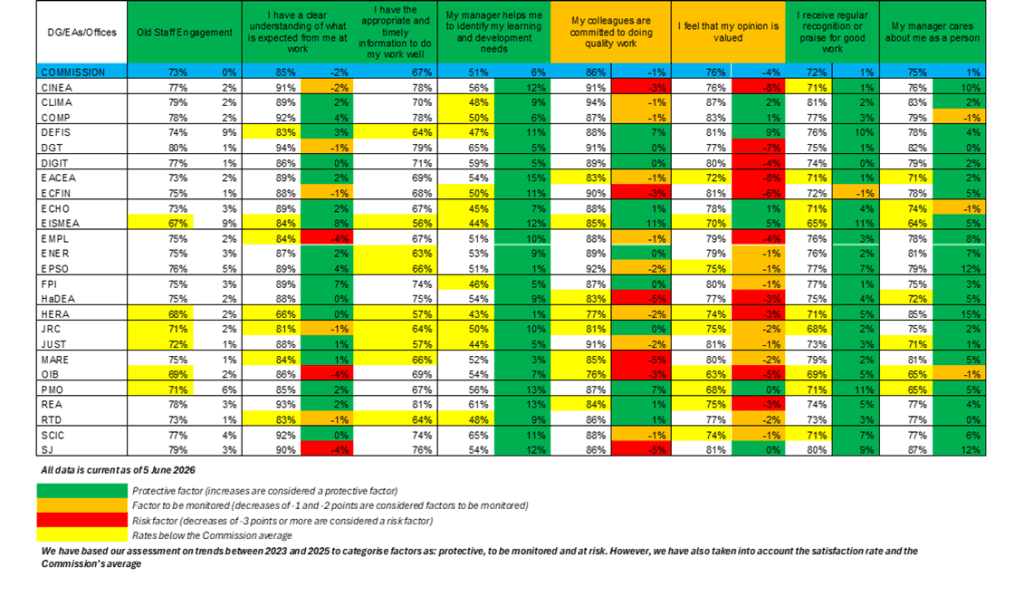
Some of these DGs have a lower satisfaction rate than the Commission average (EISMEA, HERA, JRC, JUST, OIB, PMO) but which exceed 67 %.
By comparing the results of these DGs, we found that:
1) Five protective factors
- · Social relations at work, in particular the quality of the manager ‘s social support to his staff and the consideration of “HUMAIN” in managerial practices ( For more information on this dimension, please refer to the feature: My manager cares about me as a person) – With the exception of three DGs: COMP, ECHO and OIB, all DGs increased by, inter alia, HERA by 15 points, SJ and EPSO by 12 points and CINEA by 10 points.
With the exception of three DGs (COMP, ECHO and OIB), all DGs have shown a positive trend, with HERA increasing by 15 points, SJ and EPSO by 12 points, and CINEA by 10 points.
It should be noted that in 2023, EPSO had fallen by 6 points and SJ by 4 points. This notable increase of 12 points can be attributed to an enhancement in managerial relations, particularly in terms of how middle managers are perceived to support their teams. The measures implemented have yielded tangible results.
The average result for the Commission is 75% (an increase of 1 point).
- · Recognition of work, a direct marker for Middle Management (For more information on this dimension, please refer to the feature: I receive regular recognition or Praise for good work) – with the exception of one DG: ECFIN, all DGs made progress, in particular EISMEA and PMO, by 11 points and DEFIS by 10 points.
Generally speaking, an increase of 10 points or more is typically driven by a change in management or the introduction of a new management style, or by the implementation of targeted measures following the results of the 2023 Staff Survey, or by an improvement in workload or in the working atmosphere and staff relations.
It should be noted that in 2023:
- – Overall, DEFIS experienced a significant decrease, with the exception of areas pertaining to Middle Management. It was observed that there was a 19 point increase in response to the question “My manager helps me to identify my learning and development needs” and a 3 point increase in response to the following question: “My manager is an attentive and considerate individual who takes an interest in me as an individual.”
- – EISMEA has seen a significant decrease of 11 points in staff engagement. All areas showed a decrease of between 8 and 17 points, with the exception of the question regarding the identification of learning and development needs, which demonstrated an increase of 3 points.
- – The PMO saw a decrease of 2 to 5 points across three areas, but an increase of 11 points was noted for the statement ‘My manager helps me to identify my learning and development needs’.
Based on these three examples, the role of middle management and management style proved to be decisive.
The Commission average is 72 % (+ 1 point)
- · Workplace requirements relating to resources and their availability (For more information on this dimension, please refer to the feature: I have the appropriate and timely information I need to do my work well)
As this question was not included in the 2023 survey, we were unable to analyse trends in this area. However, this question was included in the 2021 and 2018 Staff Surveys.
We note that, across all Directorates-General, this factor acts as a protective factor, enabling staff to have the information they need to do their jobs, which is a source of well-being. Across all directorates-general, this factor acts as a safeguard, ensuring staff have the information they need to do their job, which contributes to their well-being.
The Commission average is 67 %
- · The development of skills and the manager’s ability to switch to the future ( For more information on this dimension, please refer to the feature: My manager helps me to identify my learning and development needs) – although the Commission average is 51 % and we find rates below 50 % for eight DGs, all DGs without exception have progressed notably PMO and REA (+ 13 points); SJ and CINEA (12 points); DEFIS, ECFIN, SCIC (11 points); EMPL and JRC (10 points).
We have classified that factor as a protector, since, despite a rate approaching 50 % of satisfaction, real progress has been made. We would like to encourage this ongoing momentum and continue to develop it in the coming months within all departments so that staff can claim career development with new performance and skills aligned with AI and globalisation requirements.
- · Work requirements, clarity of roles and objectives ( For more information on this dimension, please refer to the feature: I have a clear understanding of what is expected from me at work. )
Although the satisfaction rate for these DGs does not fall below 81 % (apart from HERA 66 %), we see a decrease for 8 DGs/EAs/Offices: EMPL, OIB and SJ: -4 points CINEA: — 2 points, DGT, ECFIN, JRC as RTD: -1 point and DIGIT HaDEA, HERA, SCIC: 0 points. However, we see a trend for 13 DGs: EISMEA: + 8 points; FPI: + 7 points; COMP & EPSO: + 4 points; DEFIS: + 3 points…
EMPL, OIB and SJ should be monitored to ensure that staff can assess their performance against their department’s expectations and meet them effectively; otherwise, they risk experiencing stress, cognitive overload and tension with colleagues.
The Commission’s average is 85 % with a fall of 2 points.
According to these data, the results are high overall. However, the contrasting developments between DGs demonstrate the emergence of disparities, which requires increased vigilance in order to prevent a gradual deterioration in the organisational coherence of the institution’s services.
2. Two low-risk factors to be monitored:
- · Social and work relations, in particular the perception of collective engagement, the quality of work and the reliability of colleagues ( For more information on this dimension, please refer to the feature: My colleagues are committed to doing quality work). Although the satisfaction rate for these DGs/EAs/Offices does not fall below 76 %, we see a decrease for 14 out of 25 DGs, i.e. more than half: SJ, MARE and HaDEA -5 points, CINEA, ECFIN, OIB: -3 points; EPSO, HERA, JUST: – 2points and CLIMA, COMP, EACEA, EMPL and SCIC: -1 point. However, we find developments for 7 DG EISMEA: + 11 points, DEFIS and PMO: + 7points…
The Commission’s average is 86 % with a fall of 1 point.
According to these data, the labour group remains a protective factor but with the risk of gradual weakening, deterioration of team cohesion and collective disengagement in the future.
This deserves close monitoring, in so far as scientific literature shows that a deterioration in team cohesion and collective engagement may ultimately lead to a decline in cooperation, a decrease in performance and an increase in tensions which could lead to inappropriate behaviour or even psychological harassment.
- · Social relations and recognition of work, in particular the consideration and position given to the individual within his service and the institution ( For more information on this dimension, please refer to the feature: I feel that my opinion is valued). We see a fall in satisfaction for 17 out of 24 DGs/EAs/Offices: CINEA: —8 points, ECFIN and SJ: —6 paragraphs, OIB: —5 points, DIGIT and EMPL: —4 points HADEA, ERA & REA: —3 points… Nevertheless, we see a trend for 5 DGs: DEFIS: + 9 points, EISMEA: + 5 points…
The Commission’s average is 76 % with a fall of 4 points.
We would like to draw attention to these declines so that this factor can be closely monitored and does not deteriorate in the coming months, particularly in light of the Large Scale Review. A deterioration in this index would lead to staff disengagement.
The enhancement in the staff engagement index is propelled by middle management and work organisation (five protective factors), while the dimensions of participation and the work collective are somewhat fragile (two factors to monitor).
Frontline management plays a crucial role as a protective factor against occupational risks, particularly psychosocial ones.
The decline observed in 17 departments is indicative of a lack of decision-making autonomy relating to staff participation in organisational decisions that affect them, as well as staff involvement before, during and after organisational changes.
It should be noted that several epidemiological studies based on the model by Karasek and Theorell (1990) demonstrate a link between low autonomy and health problems, particularly when the phenomenon of work strain (a combination of low autonomy and a heavy workload) is observed. This phenomenon has been linked to an increased risk of developing cardiovascular and mental health conditions, such as depression, psychological distress and increased use of psychotropic drugs.
A workplace that promotes decision-making autonomy is a sign of respect and trust in its staff.
The decline observed at the level of 15 DGs in the statement “My colleagues are committed to doing quality work” highlights an important signal of fragmentation in relationships between colleagues and, consequently, within the work collective and collective autonomy. According to C. Dejours, a collective is defined by trust, loyalty among colleagues, cooperation and solidarity. This risk factor warrants monitoring. The issue may also be indicative of work overload, an inequitable distribution of work within the team, and a lack of merit-based fairness. Distributive organisational justice is based on comparisons, pitting an individual’s effort-reward ratio against that of their colleagues.
This phenomenon has been shown to increase the risks of conflict, harassment and the development of physical and mental health issues.
Although protective factors help to create a balance, it is important to monitor the following Directorates-General: CINEA, DIGIT, EACEA, ECFIN, EMPL, EPSO, HaDEA, HERA, JUST, MARE, OIB, SJ.
II.3) DGs/EAs/Offices stagnation
The Commission’s average stands with 73 % satisfaction.
We also note stagnation for 13 DGs/EAs/Offices: AGRI, BUDG, COM/SPP/REP, ENEST, ERCEA, HR, MENA, OIL, OLAF, OP, SANTE, SG and SG REFORM. Some DGs have a lower satisfaction rate than the Commission average: COMM/SPP/REP, ENEST, MENA, OIL and OP.
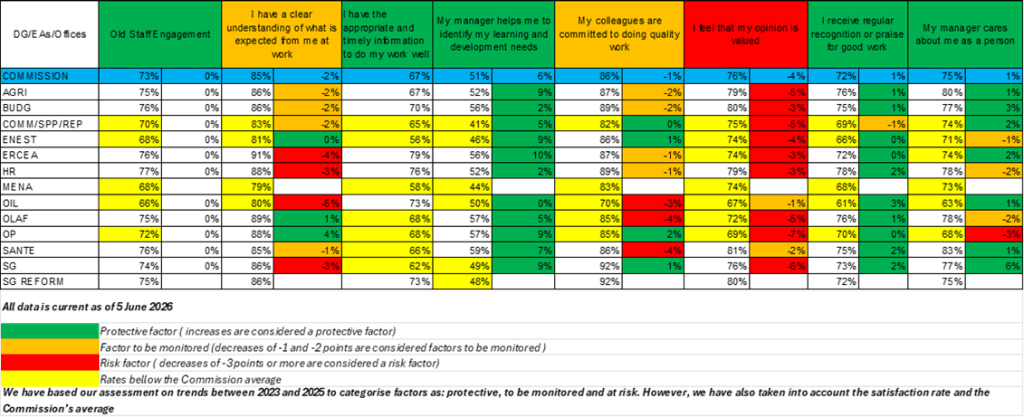
By comparing the results of these DGs, we find that:
1) Four protective factors
- · The development of skills in his support by the manager, but also the manager’s ability to switch to the future (For more information on this dimension, please refer to the feature :My manager helps me to identify my learning and development needs)
The Commission’s average is increased by 6 points.
We find an increase for 8 DGs/EAs/Offices: ERCEA: + 10 points; AGRI, ENEST, OP: + 9 points; COMM/SPP/REP, DGT, OLAF: + 5 points…
We also note that two DGs have a lower level of satisfaction than the Commission average, however, their increase is significant: ENEST + 9 and COMM/SPP/REP + 5.
- · Recognition of work, direct marker of proximity management (For more information on this dimension, please refer to the feature: I receive regular recognition or Praise for good work)
The Commission’s average is increased by 1 point.
- · Social relations at work, in particular the quality of the manager ‘s social support to his staff and the consideration of “HUMAIN” in managerial practices (For more information on this dimension, please refer to the feature :My manager cares about me as a person)
The Commission’s average increased by one point.
We find an increase for 6 DGs/EAs/Offices: BUDG: + 3 points, COMM/SPP/REP, ERCEA: + 2 points AGRI, OIL and DGT stabilise.
However, we see a decrease of 3 points for OP…
The 3 DGs decreasing as well as OIL deserve particular attention.
- · Workplace requirements relating to resources and their availability (For more information on this dimension, please refer to the feature: I have the appropriate and timely information to do my work well)
The Commission’s average is 67 %.
The majority of DGs have a rate equivalent to or above the COMM/SPP/REP share (65 %) and ENEST (56 %).
2) Two risk factors to be monitored
- · Working requirements, clarity of roles, objectives and priorities ( For more information on this dimension, please refer to the feature I have a clear understaning of what is expected from me at work )
The Commission’s average falls by 2 points.
We see a decrease for OIL: — 5 points; ERCEA: —4 points…
OP increases by 4 points…
- · Social and labour relations, in particular the perception of collective engagement, the quality of work and the reliability of colleagues (For more information on this dimension, please refer to the feature: My colleagues are committed to doing quality work)
The Commission’s average falls by 1 point.
We see a decrease for OLAF: — 4 points OIL: — 3 points…
3) One high risk factor
- · Social relations and recognition of work, in particular the consideration and place given to the individual within his service and the institution (For more information on this dimension, please refer to the feature :I feel that my opinion is valued)
The Commission’s average falls by 4 points. All the DGs mentioned above show a decrease: DGT, OP: — 7 points; AGRI, COMM/SPP/REP, OLAF: — 5 points ; ENEST: —4 points…
Conclusion
The Staff Engagement Index highlights protective factors, factors to monitor, and risk factors across DG group results, whether they have declined, improved or remained stable.
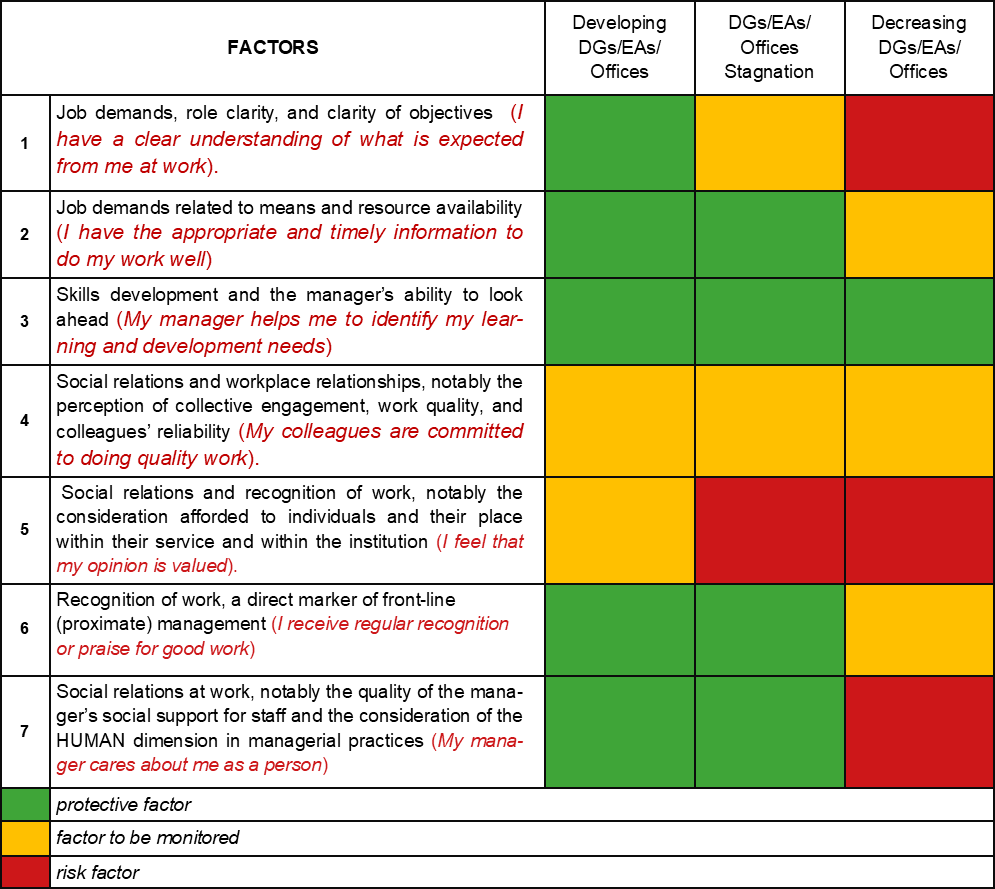
We observe:
- · A common protective factor across the three groups concerning skills development and the manager’s ability to look ahead;
- · The factor relating to job demands linked to means and resource availability is protective for DGs with improving or stable results, and to be monitored for DGs in decline;
- · The factor relating to recognition of work, a direct marker of front-line management, is protective for DGs with improving or stable results, and to be monitored for DGs in decline.
- · The factor relating to social relations—namely the quality of the manager’s social support for staff and the consideration of the HUMAN dimension in managerial practices—is protective for DGs with improving or stable results, and to be monitored for DGs in decline.
- · The factor relating to job demands, role clarity, and clarity of objectives is protective for DGs with improving results, to be monitored for DGs with stable results, and at risk for DGs in decline.
- · A common “to be monitored” factor across the three groups concerning social relations and workplace relationships—specifically the perception of collective engagement, work quality, and colleagues’ reliability.
The factor relating to social relations and recognition of work—namely the consideration afforded to individuals and their place within their service and within the institution—is to be monitored for DGs with improving results and at risk for DGs with stable or declining results.
The analysis of these results highlights a progressive differentiation among DGs with improving, stable, and especially declining results, stemming, among other things, from internal functioning within each DG and from the implementation of staff policies, notably those to combat all forms of harassment.
However, the organisational foundation remains relatively stable, particularly with respect to skills development and the manager’s ability to look ahead. This appears to be an important source of support for staff.
Middle management has developed managerial maturity, acting as a factor of organisational regulation, psychosocial support, collective engagement, and above all learning and development. Middle management has cultivated a “servant” leadership style in the service of staff, seeking to optimise their development and thereby foster autonomy.
That said, certain issues in other areas require attention and monitoring, notably workload.
With regard to workload, the ILO report states that excessive working hours remain widespread, with 35% of workers worldwide working more than 48 hours per week. This is a major psychosocial risk factor, given its link to an increased risk of cardiovascular disease and stroke.
According to the same report, psychosocial risk factors have resulted in more than 840,000 annual deaths attributable to cardiovascular diseases (strokes and ischaemic heart disease) or mental disorders (depression). These risks also result in the loss of nearly 45 million disability-adjusted life years each year. The annual economic cost of cardiovascular diseases and mental health disorders associated with these psychosocial risk factors amounts to approximately 1.37% of global GDP.
By contrast, DGs in decline show a progressive weakening across several dimensions fundamental to organisational functioning.
The factors identified (see table) are signals that should not be overlooked. They affect the personal and professional identity of staff, social relations, and the motivation of those concerned.
Overall, we note an improvement for 25 DGs, a decline for 16 DGs, and stability for 13 DGs.
In the medium to long term, if the indicators that are declining or stagnating persist, these risks becoming a “new normal,” with consequences for staff engagement and the emergence or worsening of occupational risks.
What emerges from this analysis is the crucial role of middle management and the trust it has succeeded in establishing within teams.
Even where certain indicators are declining, this reflects a degree of fatigue within middle management, which is taking on a heavy burden and shielding its staff.
It is also important to train future managers and those encountering difficulties, so that this positive dynamic is consistent across all services.
This asset—alongside workplace well-being, working conditions, and hybrid work—is essential to our institution’s attractiveness.
10 R&D recommendations
Given our analysis, R&D addresses the administration—particularly the Large-Scale Review team—10 recommendations
1. Establish a tailored occupational risk-prevention policy for each DG to strengthen engagement and well‑being and limit psychosocial risks, including those linked to new technologies and work methods.
2. Consolidate the protective role of middle management.
3. Strengthen recognition and valorisation of work.
4. Enhance organisational communication with Senior Management and the College.
5. Clarify priorities and expectations.
6. Align objectives with the resources provided, including at the workstatio level.
7. Support change during the Large-Scale Review, based on needs analyses by DG and by directorate.
8. Safeguard long-term organisational sustainability, notably by ensuring optimal working conditions through workload management
9. Support the corporate culture and its values.
10. Put the HUMAN dimension back at the heart of the institution
Cristiano SEBASTIANI,
Chair