
Staff Survey 2025 Initial Results – R&D’s Preliminary Analysis and Key Findings
R&D calls on Commissioner Serafin to translate his highly appreciated statements into concrete action
“Only by understanding where we come from can we truly know where we are heading.”
R&D calls on Commissioner Serafin to turn his above-mentioned, highly appreciated statements into concrete and immediate action, starting with…
Staff Survey 2025 – What do the initial results tell us?
1. Flexible working conditions
2. Inclusion and fairness: read…
3. Teamwork, roles and working conditions read…
4. Change & Innovation read…
5. Clarity of roles and job content: read…
6. Professional future read…
7. Well-being and work–life balanceread…
8. Senior management read…
Middle management read
Conclusion read…
Thank you, Commissioner Serafin
Today, we note with satisfaction that Commissioner Serafin has taken a clear and explicit political stance by stating:
“The Staff Survey is the Commission’s most important listening exercise, giving us the broadest possible picture of what we are doing well and where we need to improve. The results confirm that our people remain highly engaged and committed – a real strength for the institution. At the same time, the clear call for change, with 77% of staff saying we need to adapt how we work to remain relevant and effective, underlines the importance of our ongoing large-scale review, which is precisely about making the Commission stronger, more responsive, more effective, and ready for what lies ahead.”
We can only welcome, and warmly thank, Commissioner Serafin for his commitment to what is presented as a major exercise in listening to staff. This exercise is indeed essential, not least because it is supposed to inform and guide the work and conclusions of the Large-Scale Review, and to complement the working documents that staff representatives and trade unions have been waiting for, often in vain.
However, Commissioner Serafin’s commitments cannot, under any circumstances, remain purely declaratory and must be followed by concrete, visible and verifiable action.
Any failure to do so would render these commitments meaningless and would further erode staff trust.
“Only by understanding where we come from can we truly know where we are heading.”
Staff Survey: we must never forget where we come from
The staff satisfaction survey is finally becoming what it should always have been within the European Institutions: a serious, reliable and indispensable governance tool, allowing for rigorous, evidence-based analyses structured around clearly defined questions and areas.
This achievement did not come naturally, nor was it the result of enlightened management.
On the contrary, recognition of the crucial role of the Staff Survey was achieved only after years of persistent struggle, led in particular by R&D, against fierce and systematic resistance from DG HR and senior management within our institution. That resistance was driven by a clear and deliberate objective: to prevent staff from having a genuine and meaningful voice.
The same resistance explains why it has so far remained impossible to introduce a credible and meaningful 360° assessment. Certain Egos — unmistakably hypertrophic — still cannot tolerate accountability, scrutiny or contradiction. An unacceptable omission that we expect to see finally corrected in the conclusions of the Large Staff Review.
R&D nevertheless wishes again to acknowledge the decisive role played by Vice-President Georgieva, who was the first to respond to our repeated calls and who, at the time, overcame strong opposition within DG HR by imposing the implementation of a credible staff survey, one whose results would finally have to be taken seriously and acted upon.
This step was crucial not only for the Commission itself, but also for the Agencies and Joint Undertakings (JUs), making the staff survey a central and unavoidable element of the Commission’s governance responsibilities towards these bodies.
In response to repeated, deliberate and systematic attempts to deprive the Staff Survey process of the rigour it requires, attempts clearly aimed at downplaying, relativising, diluting or ultimately neutralising its results, R&D has consistently and unequivocally demanded higher, scientifically recognised standards for the organisation of staff consultations.
For our part, as R&D Federal, we turned to highly qualified and independent experts in the field to ensure that the data were analysed rigorously, objectively and without any complacency, precisely in order to prevent any distortion, instrumentalisation or suppression of staff voices.
R&D’s warnings concerning the negative results of the Staff Survey observed across several DGs, Agencies and Joint Undertakings were neither ideological, exaggerated nor opportunistic: they were rigorously grounded in facts, data and staff testimonies, and have since been repeatedly confirmed.
As usual, R&D will, as always, analyse the results of the Staff Survey 2025 thoroughly, rigorously and independently, with the support of a team of specialised experts.
However, in order to give effective follow-up to Commissioner Serafin’s statements, R&D requires that the following minimum conditions be fully respected and implemented.
R&D calls on Commissioner Serafin to turn his above-mentioned, highly appreciated statements into concrete and immediate action, starting with:
- 1. The FULL, complete and unfiltered publication of ALL results, without any exception or selective filtering whatsoever
In order to provide a comprehensive analysis and formulate essential recommendations — particularly in the context of global change and the Large-Scale Review, and in line with the welcome commitments made by Commissioner Serafin — R&D formally requests that:
- · the results be made available by DG, Directorate and large Unit;
- · the anonymised responses to open questions, as well as a summary of comments, be shared with staff;
- · this information be provided in a fully transparent manner.
Indeed, as confirmed by all experts in the field, it is imperative to conduct a detailed, service-by-service analysis of these results, precisely in order to draw targeted conclusions reflecting the specific nature of the difficulties observed, and, where justified, recognise genuine good practices.
Any attempt to dilute the findings through artificial averaging serves only to obscure accountability and perpetuate the very problems the organisation claims to address.
Invoking data protection as a blanket justification to withhold such information, when the Units concerned consist of dozens or even hundreds of staff, is no longer credible.
This practice has become a systematic instrument to avoid accountability and to prevent the identification of management failures where they actually occur.
Indeed, if Commissioner Serafin’s commitments are to be taken seriously, FULL unconditional and immediate transparency of the data is non-negotiable.
On this basis, R&D, with the support of its experts, will conduct detailed analyses at DG, Service and Executive Agency level and will transparently communicate the results of these analyses to staff.
- 2. Ensuring that the results are seriously and effectively taken into account: good intentions and public statements are no longer sufficient
Regarding the outcome of the Staff Surveys, staff have for years experienced a clear and unacceptable gap between declared commitments and actual actions.
What is no longer acceptable is a purely bureaucratic approach built on ritualistic action plans, hollow communication exercises, misplaced self-satisfaction and promises that are never honoured, all while maintaining the pretence that change is under way when, in reality, nothing changes, building a façade designed to avoid accountability.
Indeed, once full transparency in the dissemination of the data has been ensured and all analyses have been rigorously completed, all the consequences required by the results must be drawn in full, failing which the credibility of the entire process would be irreversibly compromised.
This imposes, inter alia, the need to ensure:
- a) RECOGNITION : positive results must be formally recognised and acknowledged
First and foremost, DGs and Services that have achieved positive results must be recognised and duly valued: those who have demonstrated their ability to manage the resources entrusted to them effectively must be prioritised when allocating additional resources.
- b) ACCOUNTABILITY: negative results must be equally and clearly acknowledged, without minimisation or relativisation, in order to trigger the implementation of the necessary measures and the appropriate support.
Conversely, DGs and Services with persistently negative results must explicitly acknowledge the difficulties encountered. and must be systematically supported by the central Services, namely DG HR and the Chief Confidential Counsellor, within their respective areas of competence, in the design and implementation of visible, credible and effective corrective measures.
This is particularly essential where failures concern the prevention and combating of sexual harassment have been observed over several survey cycles.
In addition, where the seriousness of the Staff Survey results leaves no room for ambiguity, Commissioners have a clear duty to step up, assume full responsibility and intervene.
Indeed, in the most critical situations, visible, direct and sustained involvement of the responsible Commissioner(s) is not optional but indispensable, not only with regard to the DGs falling under their responsibility, but equally for the Agencies and JUs whose governance they are required to ensure.
In such circumstances, continued silence or passivity cannot be interpreted as neutrality; it is perceived, rightly or wrongly, as unacceptable acquiescence to the status quo.
The importance and added value of such intervention have already been unequivocally demonstrated. Former Commissioner Ivanova set a clear precedent through her direct and decisive intervention following the disastrous EISMEA staff survey results. That intervention was explicitly recognised and welcomed by staff and proved beyond doubt that political responsibility can, and must, be exercised when governance failures become evident.
By contrast, the same level of attention, determination and political accountability that we have repeatedly, and so far, unsuccessfully, requested from Commissioner Dan Jørgensen in response to the even more disastrous results of the F4E Staff Satisfaction Survey has yet to materialise (link).
Staff Survey 2025 – What do the initial results tell us?
Pending the release of the FULL results, as well as the anonymised replies to the open-ended questions, R&D and its experts have already examined the initial results published and compared them with those of the 2023 Staff Survey.
While the overall participation rate remains the second highest ever recorded, its decline compared to 2023 cannot be ignored. We are therefore awaiting, without delay, the breakdown by DG and Services, in order to assess participation and results where they actually matter, and where problems are often concentrated.
The Commission has highlighted generally positive results in one specific area: the perception of the Commission as an employer. We do not dispute this finding. But it must not be instrumentalised to mask or relativise other, far more troubling signals.
1) Flexible working conditions
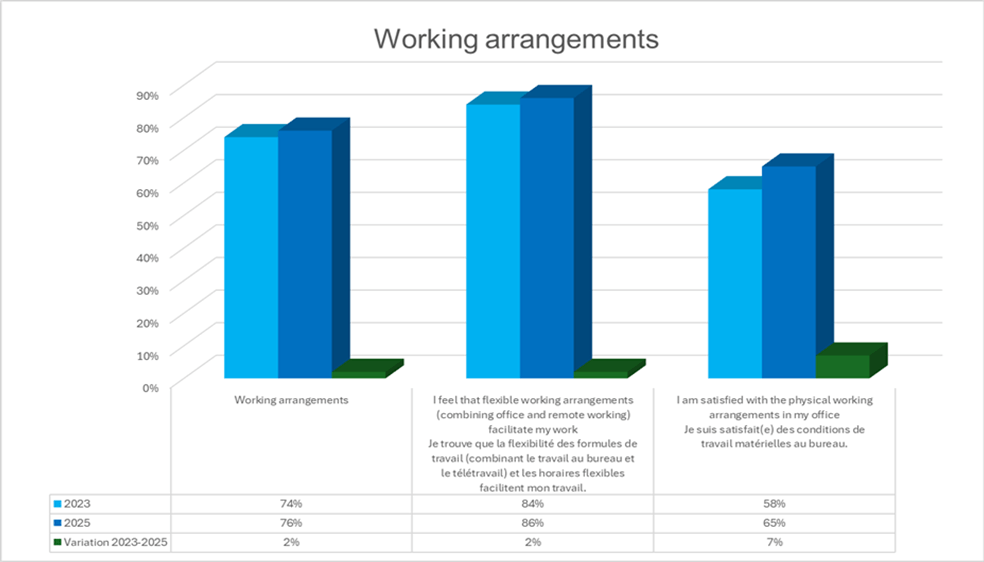
Flexibility is undisputably now a decisive factor in staff satisfaction and recruitment.
The figures are unequivocal:
- · 86% of respondents state that flexible working arrangements and flexible working hours make their work easier;
- · satisfaction with material working conditions in offices has increased to 65%.
This is positive. But partial transparency is not transparency. To properly interpret these results, a breakdown by type of office (individual offices, shared offices, dynamic collaborative spaces) is indispensable. Without it, any attempt at analysis risks being selective, incomplete or deliberately misleading.
These results clearly demonstrate that flexible working arrangements constitute a protective factor for staff well-being. Any attempt to revive simplistic or ideological narratives advocating a generalised “return to the office” would therefore be not only outdated, but irresponsible.
Strengthening work flexibility is also a key lever to improve the attractiveness of our civil service and correct geographical unbalance
At the same time, these results must be confronted with the increasingly alarming feedback coming from recruitment services regarding the declining attractiveness of the European civil service. This feedback consistently confirms that questions related to the degree of work flexibility rank among the very top concerns of candidates — often outweighing even the financial conditions offered.
This is particularly true for younger candidates and, above all, for applicants from under-represented Member States. Failing to act decisively on this front will only perpetuate the current geographical imbalance and further weaken the institutions’ ability to attract talent.
Here again, the conclusion is unavoidable: further strengthening flexibility, including flexibility beyond the place of employment, is not optional and cannot be treated as a secondary adjustment. It is a core, non-negotiable demand, clearly and consistently expressed both by staff currently in service and by prospective candidates and long supported by R&D ( link ).
This confirms the findings of the Evaluation of the Working Time Decision, which noted that “In the pulse survey, 92% of managers acknowledged that telework outside the place of employment has a positive impact on staff’s wellbeing and contributes positively to their availability (62%) and performance (61%)” and that “Almost all participants and other stakeholders (e.g. committees) see a potential improvement in the form of increasing the days of teleworking outside the place of employment” because this would make the Commission “more attractive for young(er) colleagues”.
Ignoring this reality would directly undermine staff well-being, recruitment capacity and the future attractiveness of the European civil service.
In short, the data are there. The diagnosis is clear.
What is now required is not more communication, not more selective narratives, and certainly not more delay, but political courage, accountability and concrete action.
2) Inclusion and fairness: R&D strongly welcomes the clear and measurable increase in staff satisfaction regarding the new policy to combat all forms of harassment, confirming that concrete reforms and institutional commitment can deliver tangible improvements
We were particularly pleased to note the results in this area. They clearly demonstrate that our fight has not been in vain.
For years, R&D has been at the forefront of the fight against all forms of harassment. We have done so by organising a series of dedicated conferences on the subject ( link ), by relentlessly calling out institutional shortcomings, and by securing both a revision of the harassment decision and the creation of the new position of Chief Confidential Counsellor — a long-standing and essential demand of staff representation.
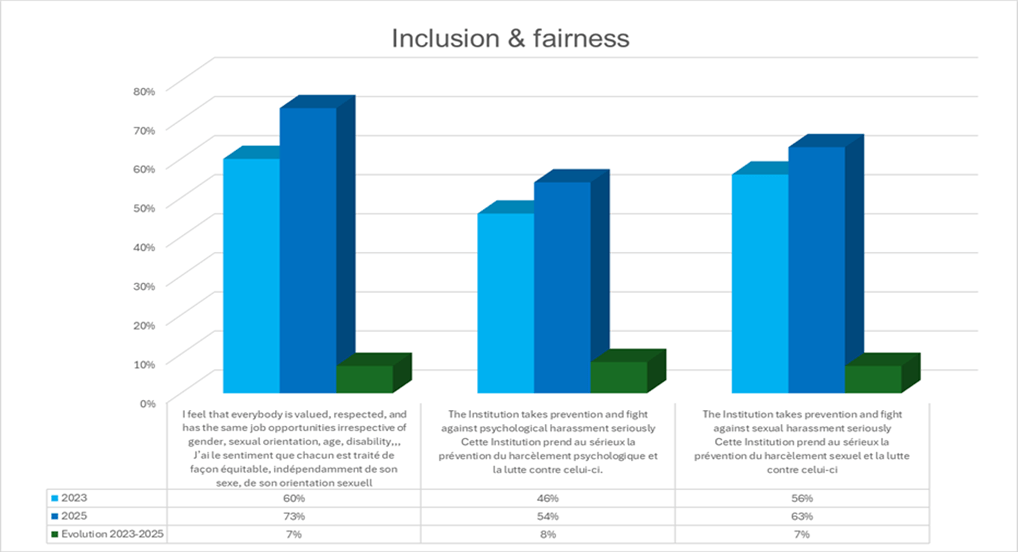
The 2025 results speak for themselves. They show a clear and measurable improvement:
- · a 7-point increase in the perception that everyone is treated fairly (73%);
- · an 8-point increase in the perception that the institution takes the prevention and combating of psychological harassment seriously (54%);
- · a 7-point increase regarding the prevention and combating of sexual harassment (63%).
These improvements confirm that structural changes, clear rules and independent safeguards do make a difference. They also show that progress is possible when the institution listens, acts and follows through on its commitments.
This is an important step forward. It must now be consolidated, monitored closely and translated into consistent practice across all services — because in this area, complacency is not an option.
It is beyond dispute that the role played, and the actions undertaken by the Commission’ CCC have been a decisive factor in shaping this positive perception.
This assessment is further and unequivocally substantiated by the fact that, following the Commission’ CCC participation in the last AASC meeting, the staff representations of the agencies and JUs unanimously called, without a single exception, for the extension of the Commission’s CCC mandate to these bodies.
On the one hand, this unanimous request is all the more significant as it was made despite sustained and, in some cases, explicit pressure from Agencies’ management, which sought to block any intervention by the Commission’s CCC and instead actively promoted the creation of a far more compliant, in-house “CCC”, better suited to managerial convenience than to staff protection. As we have clearly requested, we expect Commissioner Serafin to ensure that the Commission does not betray the trust and hopes of our colleagues ( link ).
On the other hand, such unanimity leaves no room for doubt: it constitutes a powerful, unequivocal and politically significant recognition of the CCC’s credibility, effectiveness and indispensable added value, recognition that is fully and objectively confirmed by the results of the Commission’s Staff Survey.
3) Teamwork, roles and working conditions: strong results, but vigilance required
The dimensions relating to teamwork and relations with colleagues, clarity of roles and job content, and working conditions continue to receive the highest scores. These results confirm the strength of day-to-day cooperation between colleagues and the importance of clear professional frameworks as protective factors for staff well-being.
4) Change & Innovation: between necessity and risk
In a rapidly changing world, the institution must lead by example — both in its operations and as an employer — if it is to respond effectively to global challenges and remain attractive, in particular for younger generations.
Staff are clearly aware of this reality:
- · 77% of respondents agree that “we will need to change our working methods within the institution to remain relevant and effective”;
- · 57% state that they are “excited about how AI can improve or transform parts of my work”.
Artificial intelligence is indeed becoming an essential tool for adaptable and effective day-to-day work.
However, it cannot and must not become an end in itself, nor an unsustainable or dehumanising technology. AI must be deployed in a way that makes sense, adds value and meaning to work, and strictly respects ethical, professional and human boundaries. Under no circumstances can it replace human judgement, responsibility or accountability.
To this end, R&D has already mobilised leading experts, such as Jérémy Lamri, on artificial intelligence and the future of work (REPLAY – Conference – Artificial Intelligence and the Future of Work – Renouveau & Démocratie).
R&D will also shortly organise a dedicated cycle of conferences and reflection on these issues, involving all staff, with the aim of promoting an informed, responsible and human-centred approach to change.
At the same time, it must be recalled that uncontrolled, poorly planned or ill-considered change and innovation constitute well-documented psychosocial risk factors. They are closely linked to job insecurity and can generate stress, anxiety, mental fatigue, cognitive overload, a deterioration of the social climate and, ultimately, a decline in performance.
5) Clarity of roles and job content: excellent results, but early warning signals
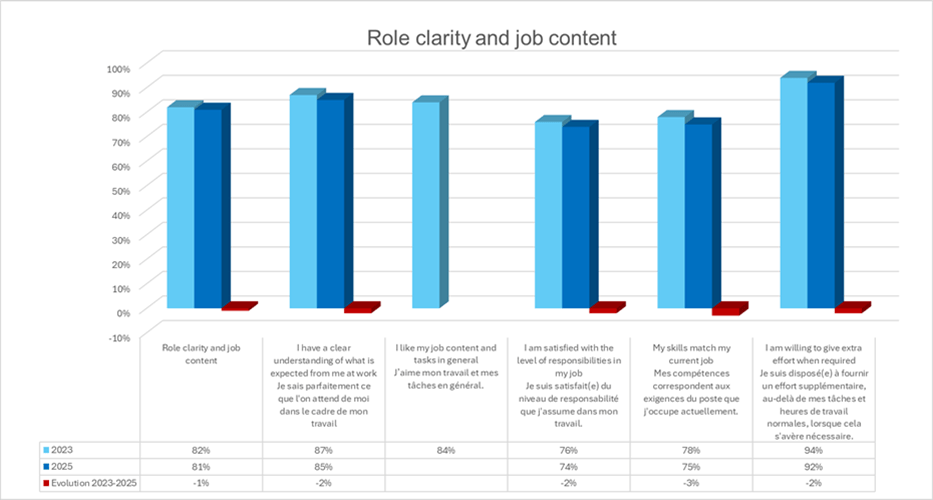
When comparing the 2025 results with those of 2023, the scores relating to clarity of roles and job content remain excellent overall. However, we note a slight decline ranging from –1 to –3 percentage points.
While this decrease is far from alarming at this stage, it must not be ignored. It calls for careful interpretation, monitoring and follow-up. We are therefore awaiting the breakdown of results by DG and Services in order to identify where this decline is occurring and to cross-reference the data so as to understand its underlying causes.
Strong results today do not eliminate the need for vigilance tomorrow — especially in a context of accelerated change.
6) Professional future: a long standing structural failure
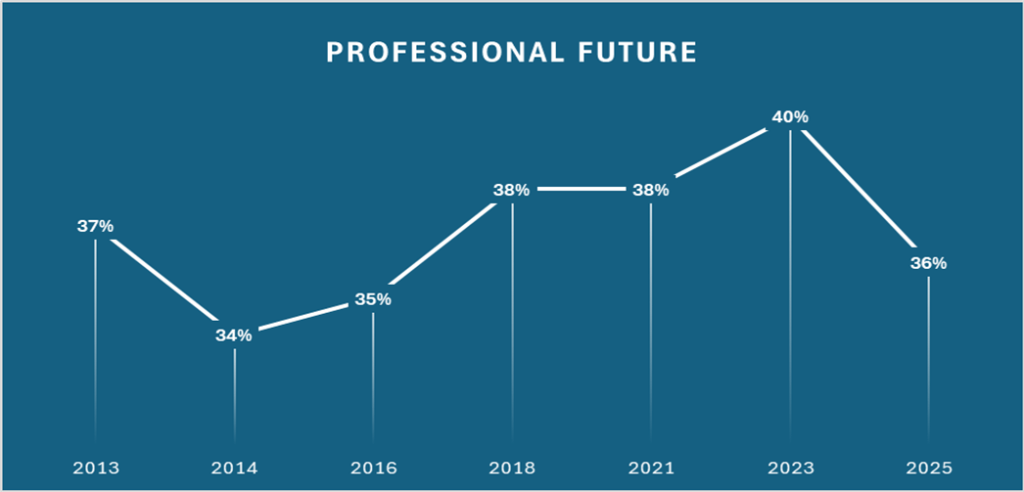
The dimension relating to professional future has been in a state of persistent deterioration since 2014, with no meaningful or structural improvement.
Only 27% of respondents consider that “if I want to change jobs, there are enough opportunities available”, while just 46% state that they are “well informed about their career opportunities” — a figure unchanged since 2023.
Our initial analysis, pending receipt of the full results, already points to a major psychosocial risk factor linked to social relations at work. For more than a decade, staff have been confronted with a chronic lack of career prospects, leading to loss of motivation and engagement, prolonged stress, and, in many cases, burnout, harassment situations and disengagement.
This situation is neither new nor accidental. It reflects a systemic failure to address career development, despite repeated warnings and survey results pointing in the same direction year after year. We will, of course, deepen our analysis once the final results are made available.
7) Well-being and work–life balance: stagnation with serious consequences
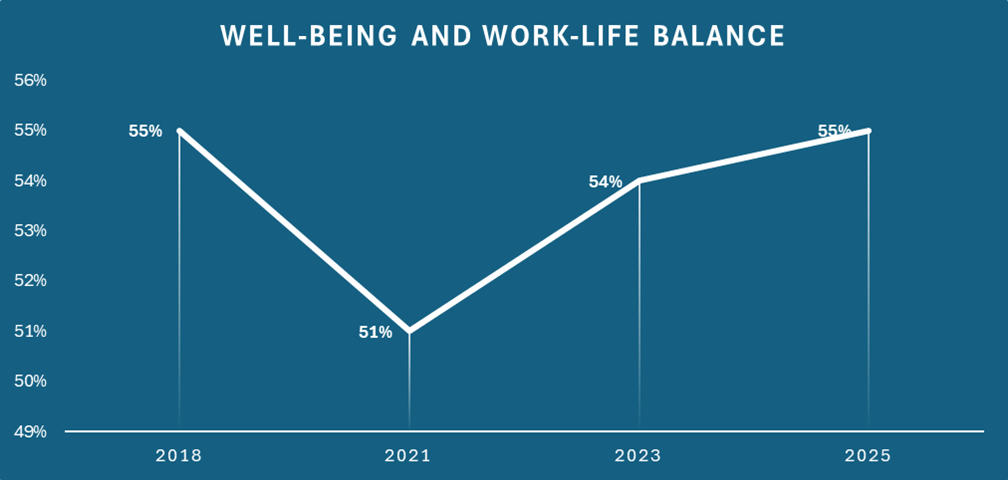
The well-being and work–life balance dimension has also been suffering since 2014, with a worrying stagnation over time. The fact that only 46% of staff see the Commission as caring about staff wellbeing is alarming and will need to be prioritised in the analysis of and follow-up to the detailed results.
A detailed analysis is required, both overall and by DG, in particular with regard to the questions “My workload is acceptable” and “I manage to maintain a good work–life balance”.
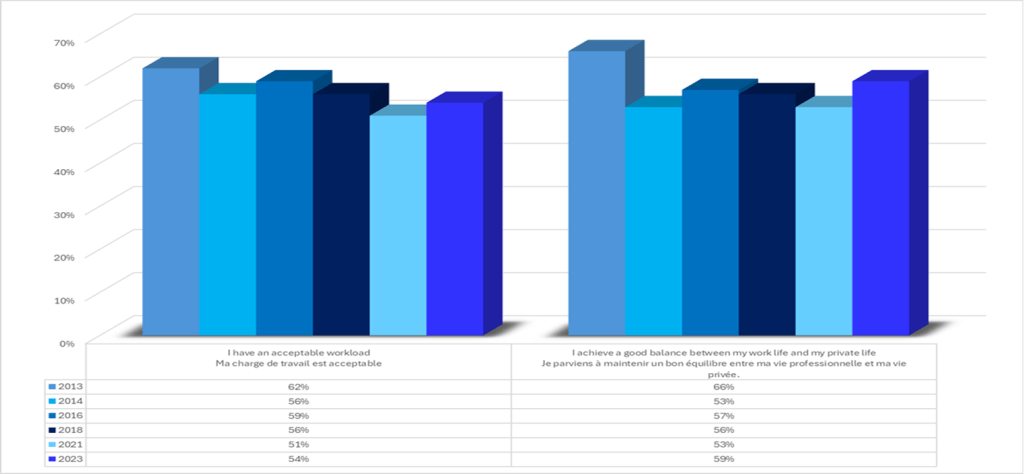
Since 2014, satisfaction rates for these responses have not reached those of 2013: 62% for ‘I have an acceptable workload’ and 66% for ‘I achieve a good balance between my work and private life.
These results point to psychosocial risk factors related to work intensity and working time, generating chronic stress and mental fatigue. In the long term, such conditions are known to lead to burnout, physical and psychosomatic disorders (sleep disorders, musculoskeletal pain, headaches, digestive disorders, etc.), as well as tensions in private and family life.
8) Senior management: words without example
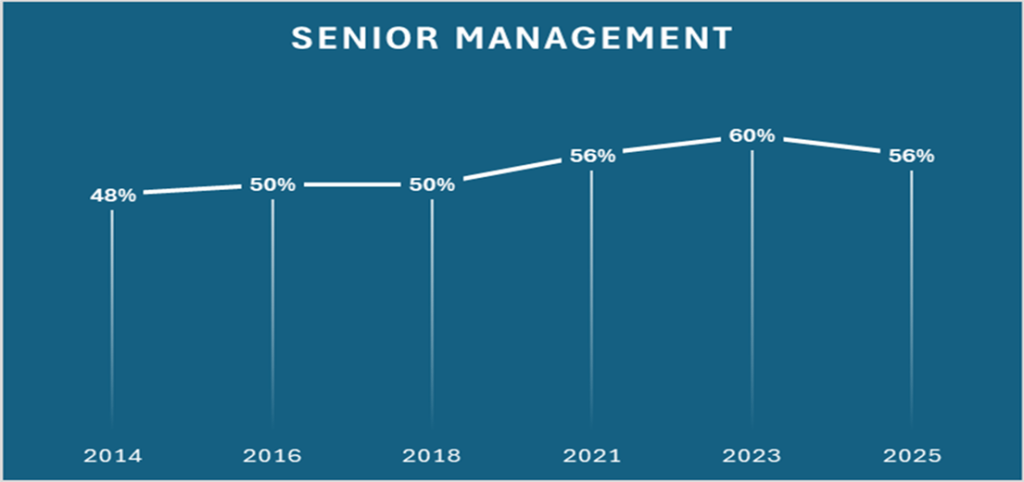
The results relating to senior management have also been persistently poor since 2014.
Senior management must finally, in practice and not through empty slogans, lead by example and demonstrate genuine proximity to staff.
This dimension is directly linked to social relations at work. When these deteriorate, they become a major source of stress and psychological tension, resulting in a degraded social climate, declining engagement and performance, increased absenteeism and a profound loss of trust.
9) Middle management: a protective factor
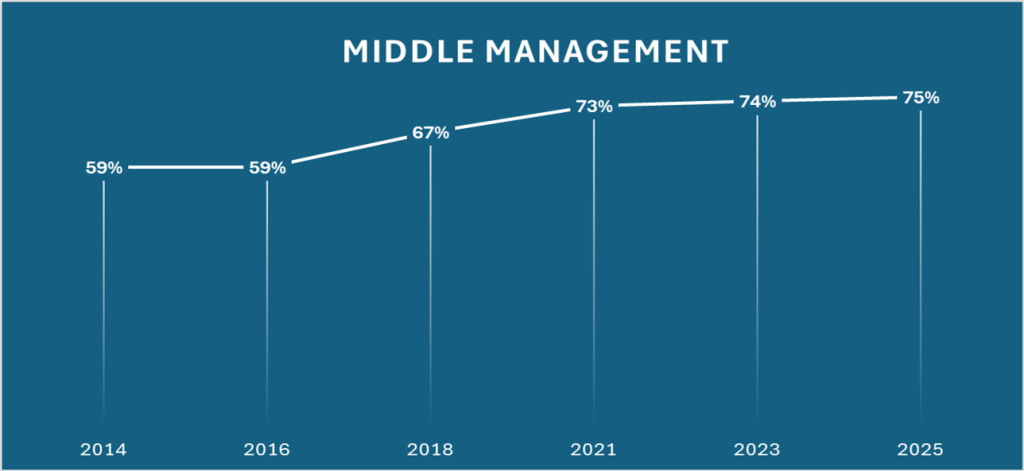
Fortunately, the initial positive results once again confirm that middle management has acted as a protective factor for several years.
Conclusion
In line with the above-mentioned position, he has taken, which we have greatly appreciated, we expect Commissioner Serafin to ensure that Staff Survey results systematically and without exception translate into concrete, visible and measurable consequences, and not into rituals, narratives or cosmetic exercises.
It must be stated clearly and unequivocally, once and for all, that the Staff Survey is neither a bureaucratic formality nor a communication tool.
It is a mechanism of accountability and action.
It is not designed to generate data that are selectively praised when convenient and quietly buried when uncomfortable.
The profound change in practices repeatedly invoked in the context of the Large-Scale Review can no longer remain at the level of intentions, declarations or carefully worded commitments, however appreciated they may be.
If this change is to be credible, it must translate into a radical and observable transformation in the way Staff Survey results are disclosed, interpreted and, above all, acted upon.
This requires a clear and definitive rupture with practices that have, for far too long, undermined trust and credibility: partial or delayed publication of results, selective framing of data, systematic minimisation of negative findings, relativisation of unmistakable warning signals, and the persistent refusal to draw consequences from what staff are expressing in a clear, consistent and repeated manner.
These practices are no longer tolerable. They actively erode trust, hollow out governance, and directly perpetuate the very dysfunctions the Staff Survey is meant to expose and correct.
Responsibility must therefore be fully and explicitly assumed at all levels, including, and especially, at the highest political level.
What is required now is not further commentary, but leadership that listens, accountability that acts, and governance that delivers tangible and verifiable change.
Anything short of this would not only constitute a betrayal of staff expectations; it would seriously and lastingly damage the credibility of the institution itself.
Cristiano SEBASTIANI,
President