
Psychosocial risks,
Stress and
Mental health at work
Breaking news
The Commission Must First “Talk the Talk” before “Walking the Talk” with Member States.
The EP has adopted a resolution containing recommendations to the Commission on psychosocial risks, stress and mental health at work (2026/2023(INL), resolution), calling on the Commission to submit a legislative proposal.
R&D calls for urgent and effective actions.
For years, despite R&D’s repeated requests and warnings, psychosocial risks have manifestly been underestimated by the Commission. Although some modest progress has ultimately been achieved, the measures adopted to date remain far from sufficient to ensure effective prevention and adequate protection of staff.
In its resolution of 6 October 2026 on psychosocial risks, stress and mental health at work (2026/2023(INL)), the European Parliament calls upon the Commission to submit a legislative proposal aimed at ensuring that psychosocial risks are finally adequately addressed across the Member States, notably through the establishment of genuinely effective prevention, protection and redress mechanisms.
Let’s avoid another embarrassing “Here we go again” moment, like the one we are currently witnessing in the field of whistleblower protection, where the Commission is only now, and with considerable delay, attempting to “walk the talk” within its own administration.
Concerning whistleblower protection, the Commission, having been instrumental in the adoption of a Directive of which we can rightly be proud, and having challenged Member States, including before the Court of Justice, for failing to comply with the principles underpinning that Directive, has only very recently, and with considerable delay, initiated negotiations to amend its own internal procedures, with a view to bringing them into line with the very principles and safeguards enshrined in that Directive.
When it comes to psychosocial risks, the Commission must first “talk the talk” by unequivocally committing to the highest standards of prevention and protection for its own staff, before seeking to “walk the talk” towards Member States through new legislation.
For its legislative initiative to be credible, the Commission must first demonstrate, through concrete and effective measures, that the very standards of prevention and protection it intends to promote throughout the European Union are already fully upheld within its own administration.
Accordingly, in parallel with the preparation of the legislative proposal requested by the European Parliament, urgent and substantial improvements must be made to the prevention, assessment and management of psychosocial risks within the Commission itself.
To this end, R&D calls upon the Commission:
- • To immediately initiate a genuine and comprehensive social dialogue with staff representatives on all relevant internal procedures.
This with a view to reviewing and, where necessary, substantially amending them to ensure full compliance with the highest possible standards of prevention, protection, procedural safeguards and respect for staff rights. Such dialogue must lead to concrete, effective and enforceable improvements rather than merely formal or cosmetic adjustments.
- • To provide the relevant services within DG HR with the additional human and financial resources, and in particular the specialised expertise, necessary to discharge their responsibilities effectively.
In this context, R&D wishes to acknowledge the dedication, commitment and efforts of the colleagues within DG HR responsible for this particularly sensitive area, who have been carrying out their duties under difficult conditions, with insufficient resources and without the genuine political support necessary to address these challenges effectively.
- • To finally give effect to the longstanding demand of the staff representation to transfer the Internal Service for Prevention and Protection at Work (ISPPW/SIPP) from the OIB to DG HR, where staff policies are formulated and approved.
Indeed, the ISPPW was previously attached to DG HR, and its transfer to the OIB took place in connection with the appointment of its former Head of Service. R&D therefore calls for the restoration of the previous organisational arrangement, thereby ensuring that the service operates at the appropriate institutional and decision-making level, with the functional independence, operational autonomy and authority necessary to fulfil its statutory prevention and protection responsibilities effectively and impartially.
- • To ensure, in accordance with the applicable legal requirements, that the ISPPW is provided with at least one duly qualified Prevention Adviser specialising in Psychosocial Aspects at Work, whose functional independence, neutrality and impartiality must be fully guaranteed.
This adviser must have the necessary expertise, authority and resources to address all work-related psychosocial risks, including through both informal and formal psychosocial intervention procedures, while ensuring full respect for confidentiality, procedural safeguards and the rights of all staff members concerned.
The time for limited adjustments and purely declaratory commitments is over.
R&D calls upon Commissioner Serafin to ensure that the Commission finally starts by “talking the talk”, committing unequivocally to the highest standards of prevention and protection against psychosocial risks for its own staff, before “walking the walk” by translating those commitments into concrete, effective and enforceable measures.
Only by leading by example and ensuring that the highest standards of prevention and protection are effectively upheld within its own administration can the Commission safeguard its institutional credibility, reinforce the legitimacy of its legislative initiative and credibly call upon Member States to implement those same standards across the European Union.
R&D’ detailed Legal Analysis of the European Parliament Resolution on Psychosocial Risks, Stress and Mental Health at Work (2026/2023(INL)
For years, despite R&D’s repeated requests and warnings, psychosocial risks have manifestly been underestimated by the Commission. Although some modest progress has ultimately been achieved, the measures adopted to date remain far from sufficient to ensure effective prevention and adequate protection of staff.
In its resolution of 6 October 2026 on psychosocial risks, stress and mental health at work (2026/2023(INL)), the European Parliament calls upon the Commission to submit a legislative proposal aimed at ensuring that psychosocial risks are finally adequately addressed across the Member States, notably through the establishment of genuinely effective prevention, protection and redress mechanisms.
What R&D has advocated for years within the European institutions is now becoming a European priority!
On 6 October, the European Parliament adopted a resolution containing recommendations to the Commission on psychosocial risks, stress and mental health at work (2026/2023(INL), resolution), calling on the Commission to submit a legislative proposal.
The proposed legislation would seek to:
“…lay down minimum requirements to prevent, eliminate or, where this is not possible, reduce work-related psychosocial risks and their potential outcomes which may include, inter alia, work-related stress, burnout, including cyber violence and harassment, bullying, mental disorders, including post-traumatic stress disorder, moral distress and trauma-related conditions, addiction or suicidal behaviour, cardiovascular diseases and musculoskeletal disorders, in full respect of the competences of the Member States and of the principles of subsidiarity and proportionality.”
It would also seek to:
“…establish organisational, structural and participatory obligations for employers in order to protect workers’ mental and physical health and to ensure safe and dignified working conditions.”
The work undertaken by the European Parliament now lends substantial support to the analyses, findings and demands consistently advanced by R&D over several decades.
R&D welcomes this development and takes pride in having contributed to bringing these issues to the forefront of the European debate.
The EP resolution is an Unprecedented Step Forward…
Human dignity in the workplace is non-negotiable. Every individual’s professional identity must be respected and protected and must under no circumstances be undermined or called into question.
Safeguarding that dignity and strengthening its protection through a robust regulatory framework, adapted to developments in the world of work, are among R&D‘s key policy priorities.
We have consistently worked to protect staff, provide them with support and ensure that they are fully informed of their rights across all EU institutions.
Putting PEOPLE back at the heart of our institution has always been, and will remain, our guiding principle.
When, supported by the experts assisting us, we first drew attention to the European Commission’s shortcomings in the management and prevention of psychosocial risks affecting its staff, the response was to portray us as unrealistic idealists.
On the one hand, we have never failed to pay tribute to the dedication and commitment of the colleagues responsible for this matter, who have been required to carry out their duties under particularly difficult circumstances, without the benefit of any genuine political impetus or determination at the highest level to drive meaningful progress on this issue.
On the other hand, far from being discouraged by such attitudes, and recognising that staff health and well-being constitute a major priority for R&D, we sought the assistance of internationally recognised experts in the field in order to develop concrete, sustainable and evidence-based proposals.
Drawing on our extensive practical experience, we have consistently emphasised that psychosocial risk factors are multiple, interdependent and cannot be adequately assessed or addressed in isolation.
This is precisely the approach now reflected in the European Parliament’s resolution.
Effective prevention requires a comprehensive and systemic approach, encompassing working conditions and work organisation, management practices, social and professional relationships, workload and its distribution, emotional demands and conflicts of values.
Such an approach necessarily requires moving beyond a model focused primarily on the individual and addressing the organisational and structural factors that give rise to psychosocial risks.
Furthermore, scientific research has highlighted the potential risks of mental fatigue and cognitive overload arising from the intensive use of artificial intelligence in the workplace.
These emerging risks require heightened vigilance and must be incorporated into psychosocial risk assessments, with a view to establishing appropriate preventive measures.
For R&D, technological innovation must never come at the expense of staff members’ mental health, professional autonomy or well-being.
Above all, the prevention of psychosocial risks cannot be confined to addressing the consequences of work-related suffering. It must primarily tackle its underlying causes, particularly those of an organisational and structural nature.
Yet, over recent decades, we have witnessed a growing prevalence within Commission departments of psychosocial risk factors and their consequences for staff health and well-being, including harassment, burnout and stress.
Protecting health is not a matter of organising holistic well-being sessions. It requires genuine expertise, professional competence and effective preventive action.
This is precisely why we have invested in specialised training and expertise concerning both the prevention of psychosocial risks and the applicable legal framework.
We have repeatedly drawn attention to risk factors, in particular excessive workloads and increasing work intensity, partly resulting from structural understaffing following successive budgetary restrictions.
We have called for a comprehensive psychosocial risk assessment, followed by the establishment and implementation of a genuine psychosocial risk prevention policy.
We have reminded the institution of its obligations as an employer, notably under Article 1e of the Staff Regulations and Council Directive 89/391/EEC on safety and health at work.
Thanks to the sustained efforts of R&D and staff representatives, progress was achieved in reviewing the institution’s policy for combating all forms of harassment (2023 Decision).
Nevertheless, we have continued to denounce shortcomings in the implementation of that policy, particularly as regards the handling of requests for assistance under Article 24 of the Staff Regulations and the conduct of formal administrative investigations.
We therefore welcomed the fact that our concerns and demands were taken into account by the European Parliament in the context of the Commission’s 2024 discharge procedure, through its request for an independent study to be conducted under the auspices of the Chief Confidential Counsellor.
We await the findings of that study with considerable interest.
R&D actions over the years
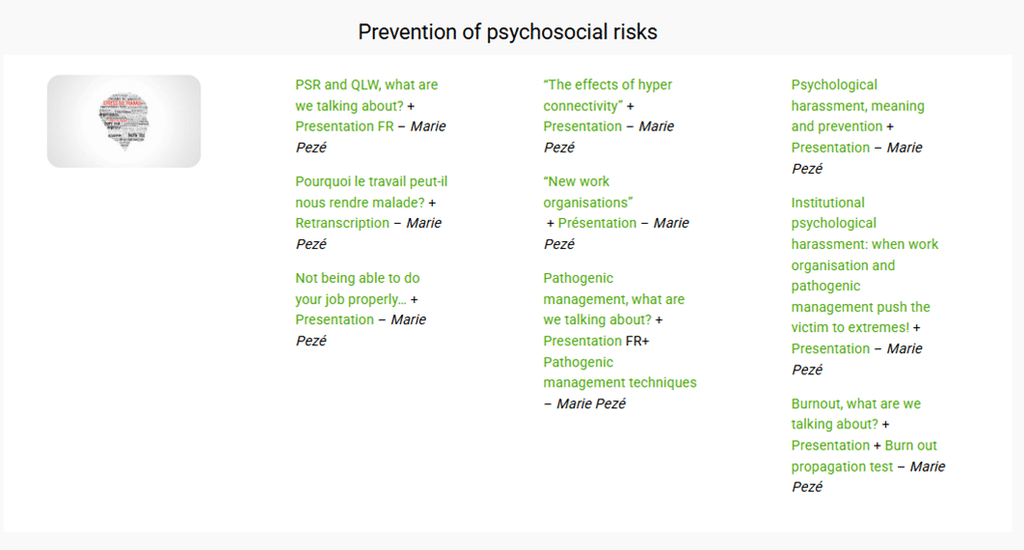
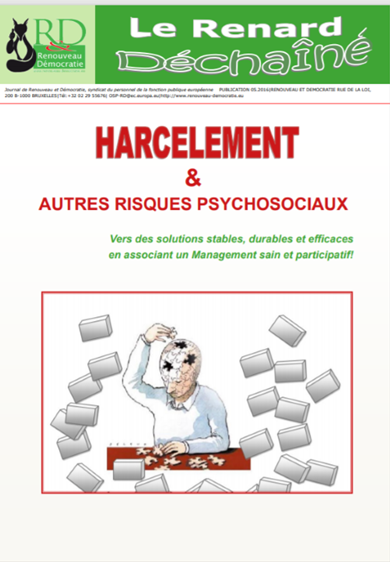
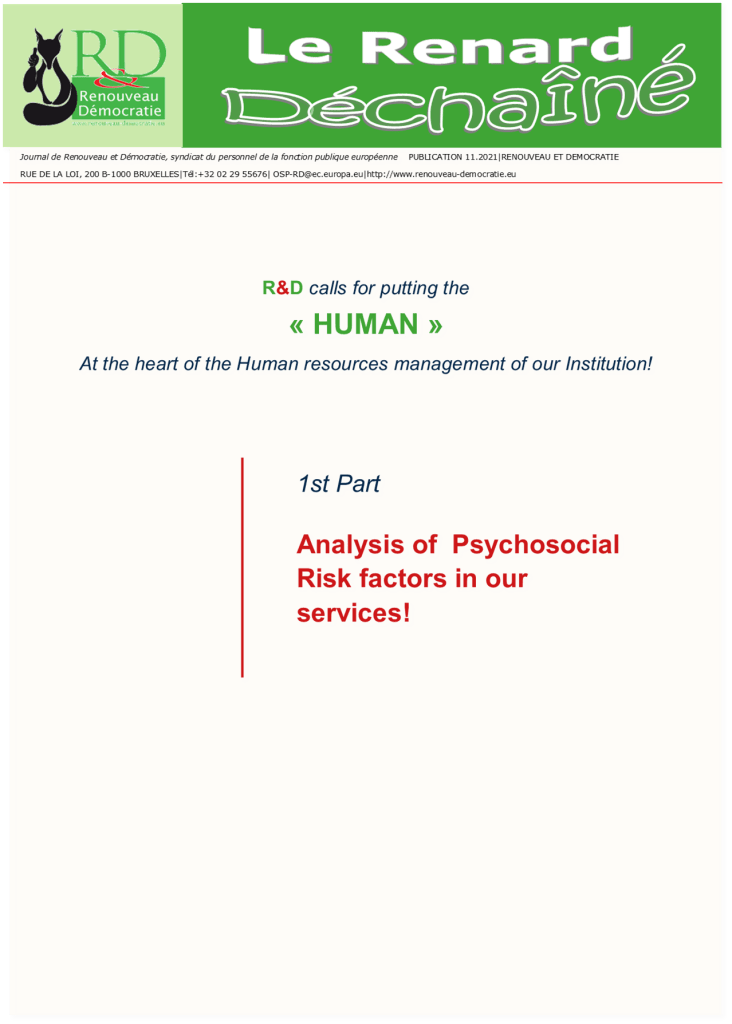
Against this background, several aspects of the European Parliament’s resolution deserve particular attention
- 1. Definitions
The European Parliament’s approach confirms R&D‘s longstanding analysis of psychosocial risks and their underlying factors
Recommendation 3 — Definitions
Work-related psychosocial risks
“work-related psychosocial risks” means work-related risks arising from exposure to psychosocial risk factors, which affect workers’ mental and physical health, safety and dignity; such risks may lead, inter alia, to work-related stress, burnout, mental health issues, addiction or suicidal behaviour, cardiovascular diseases and musculoskeletal disorders, which may lead to job loss, termination of employment, or pressure to resign.”
Psychosocial risk factors
“work-related risk factors related to the organisation, design and management of work, its social and relational context and working conditions, including:
- · An Excessive workload and high work intensity;
- · Long and often unpredictable working hours;
- · Presenteeism;
- · Lack of autonomy;
- · Lack of support from supervisors
- · Psychological and sexual harassment;
- · Violence, including cyber violence and harassment;
- · Discriminatory behavior;
- · Exposure to adverse working relationships and workplace bullying;
- · High emotional demands;
- · Violation of personal dignity, devaluation of professional identity, and the undermining of performance;
- · High digital intensity, in particular digital connectivity outside working time, or being subject to automated decision-making or constant automated monitoring and undue excessive surveillance;
- · Lack of role clarity and ineffective communication,
- · customer evaluation by real-time ratings systems;
- · Unrealistic targets.”
The European Parliament also addresses climate-related psychosocial risks and their consequences, including heat stress.
R&D representatives on the Committee for Prevention and Protection at Work (CPPT) have already drawn attention to the need for a heatwave protocol and to the risks of heat stress affecting staff required to work in conditions of extreme heat.
- 2. Employers’ Obligations
R&D has consistently relied on the fundamental principles established by Council Directive 89/391/EEC on the introduction of measures to encourage improvements in the safety and health of workers at work, emphasising the employer’s responsibility to ensure the protection of staff members’ physical and mental health.
On this basis, R&D has repeatedly advocated the implementation of a genuine prevention policy founded on the general principles of prevention, including the obligation to avoid risks, combat risks at source and adapt work to the individual.
See: Prevention of Psychosocial Risks — Renouveau et Démocratie.
The European Parliament reinforces R&D‘s longstanding demands
The European Parliament considers that:
“Psychosocial risks are the responsibility of the employer and must be addressed primarily through collective and organisational prevention measures.”
Recommendation 1 — Subject Matter and Purpose
The aim of the proposal should be to lay down minimum requirements to prevent, eliminate or, where this is not possible, reduce work-related psychosocial risks and their potential outcomes which may include, inter alia, work-related stress, burnout, including cyber violence and harassment, bullying, mental disorders, including post-traumatic stress disorder, moral distress and trauma-related conditions, addiction or suicidal behaviour, cardiovascular diseases and musculoskeletal disorders, in full respect of the competences of the Member States and of the principles of subsidiarity and proportionality.
It should establish organisational, structural and participatory obligations for employers in order to protect workers’ mental and physical health and to ensure safe and dignified working conditions.
Recommendation 4 — General prevention obligation
Employers should ensure the prevention of work-related psychosocial risks.
To that end, the general principles of prevention laid down in Article 6 of Directive 89/391/EEC should apply…
…Within the context of work-related psychosocial risks, developing a coherent overall prevention policy should be understood as including measures on safe staffing levels.
Furthermore, the European Parliament recognises the importance of secondary prevention in protecting workers’ health.
In particular, it considers that:
Secondary prevention plays a key role in protecting workers’ health by enabling the early detection of work-related health impairments, in particular those linked to psychosocial risks…”
The Parliament also emphasises that a clear and structured approach to secondary prevention can contribute to reducing the duration of sickness absences, facilitating sustainable returns to work, alleviating health-related symptoms following periods of absence and preventing recurrence.
- 3. Psychosocial Risk Assessment and Action Plans
R&D has repeatedly called for the implementation of a comprehensive occupational risk assessment, including psychosocial risks, based on a rigorous scientific methodology and taking into consideration all the risk factors identified above.
Such an assessment must be regularly updated and systematically reviewed whenever significant organisational restructuring takes place or substantial changes are introduced to working conditions.
It must result in a concrete action plan incorporating appropriate preventive measures, a clearly defined implementation timetable and regular monitoring, particularly through the Committee for Prevention and Protection at Work (CPPT) and the Health and Safety at Work Committees (CSHT).
For R&D, psychosocial risk assessment must never be reduced to a mere administrative or compliance exercise.
It must constitute a genuine instrument of primary prevention, capable of identifying the organisational causes of psychosocial risks and bringing about lasting improvements in working conditions and the working environment.
The European Parliament confirms the relevance of R&D‘s demands
Recommendation 5 — Psychosocial Risk Assessment and Action Plan
“Employers should carry out regular psychosocial risk assessments and whenever significant changes to the organisation of work and organisational restructuring occur, including where such changes lead to notable fluctuation in staffing levels, high instances of workplace sick-leave, and a prevalence of long-term and/or repeated absences. Additionally, workers’ representatives should have the possibility to propose an assessment based on their reasoned evaluation.”.
The ongoing discussions in the context of the Large Scale Review make the need for a prior psychosocial risk assessment particularly urgent.
There is still time to initiate such a preventive exercise, both at institutional level and within individual departments, particularly those likely to undergo significant changes, including SCIC, DGT, Offices, childcare facilities and transport services.
The purpose must be to identify, assess and anticipate the potential consequences of this major exercise for staff health, working conditions and well-being before any decisions concerning its implementation are taken.
Recommendation 6 — Work reorganisation and technological change
The European Parliament emphasises that:
“Any significant restructuring, reorganisation of work, including teleworking arrangements, shifts in workforce levels or introduction of automated decision-making and automated monitoring systems, where significant impact on workers is expected, should be subject to a prior psychosocial risk assessment by employers in cooperation with workers and their representatives.”
This requirement is of particular importance in the present institutional context.
- 4. The Importance of Clear Procedures and Respect for Victims’ Rights
The European Parliament confirms R&D‘s demands and the critical observations addressed to the Commission during the 2024 discharge procedure — matters that will also be closely pursued in the context of the 2025 discharge procedure
The European Parliament underlines:
“the importance of clear, confidential, independent and accessible procedures to address cases of harassment, violence and discrimination at work, including cases involving abuse by colleagues, supervisors or management, ensuring protection against adverse treatment and respect for victims’ rights.”
These principles are fundamental to ensuring that the rights of victims are effectively protected and that allegations of harassment, violence or discrimination are examined through procedures that are genuinely impartial, independent and capable of providing effective protection.
- 5. Whistleblower Protection
The European Parliament confirms R&D‘s longstanding demands
Recommendation 10 — Reporting and Protection Against Retaliation
“Workers should have the right to report, including anonymously, through effective channels, work-related psychosocial risks that they have identified or been affected by.
Workers’ representatives should be informed and consulted in the design and monitoring of those effective reporting channels.
Appropriate safeguards should be put in place to prevent any form of retaliation, discrimination or disadvantage as a result of such reporting.”
These recommendations are fully consistent with the concerns repeatedly expressed by R&D regarding the need to guarantee effective protection for staff members who report wrongdoing, serious dysfunctions or risks affecting their health, safety and dignity.
See also:
- 6. Return to Work Following an Absence Related to Psychosocial Risks
Drawing on our practical experience, we have observed that colleagues returning to work after periods of absence due to health conditions associated with psychosocial risks are particularly vulnerable.
Some experience considerable difficulties in regaining their professional bearings, suffer from diminished self-confidence, feel stigmatised or face a risk of relapse, particularly where the working conditions that originally contributed to their health problems remain unchanged.
In response to these findings, R&D has repeatedly called for the establishment of a genuine return-to-work policy based on individualised support, appropriate assistance measures and a gradual, safe and sustainable reintegration process.
Such a policy must also ensure that the organisational and psychosocial factors which contributed to the absence are properly identified and addressed.
This is essential to prevent recurrence and to promote a lasting return to work in an environment that respects staff members’ health and dignity.
The European Parliament confirms R&D‘s demands
Recommendation 8 — Supporting a Sustainable Return to Work
“Workers who have been absent from work long-term or for repeated periods of time due to health impairments linked to work-related psychosocial risks, including work-related stress, bullying, burnout, harassment or violence, should have the right to a supported and sustainable return to work.”
- 7. Towards the Recognition of Occupational Diseases Associated with Psychosocial Risks
R&D has repeatedly advocated the recognition of health conditions arising from exposure to psychosocial risks as occupational diseases, particularly occupational burnout.
We therefore welcome the approach adopted by the European Parliament in its resolution, which:
“Calls on the Commission and the Member States to explicitly recognise that work-related psychosocial risks give rise to occupational diseases, including mental health issues.”
The Parliament further:
“Calls on the Commission, in cooperation with relevant bodies including the Advisory Committee on Safety and Health at Work, to review and, where necessary, amend Commission Recommendation (EU) 2022/2337 of 28 November 2022 concerning the European schedule of occupational diseases(26) accordingly”
Conclusion
For R&D, human dignity, mental health and respect for staff must remain at the heart of every prevention policy and every process of social dialogue.
We do not claim any particular merit for having drawn attention to the shortcomings in the management of psychosocial risks within our institution. As usual, we have simply sought to apply the findings of the most highly qualified experts and the best available professional practices.
If the Commission now proceeds to give effect to the European Parliament’s recommendations and seeks to promote equivalent requirements at Member State level, it risks finding itself in a particularly uncomfortable position.
An institution that seeks to uphold fundamental standards of protection across the European Union must first demonstrate its own compliance with those standards as an employer.
Effective prevention cannot be achieved without genuine and constructive consultation with staff representatives, whose first-hand knowledge of working conditions constitutes an indispensable resource for developing lasting and effective solutions.
R&D calls upon Commissioner Serafin to ensure that the Commission finally starts by “talking the talk”, committing unequivocally to the highest standards of prevention and protection against psychosocial risks for its own staff, before “walking the walk” by translating those commitments into concrete, effective and enforceable measures.
Only by leading by example and ensuring that the highest standards of prevention and protection are effectively upheld within its own administration can the Commission safeguard its institutional credibility, reinforce the legitimacy of its legislative initiative and credibly call upon Member States to implement those same standards across the European Union.
Cristiano SEBASTIANI,
Chair