
Brussels, 29 September 2026
Note for the attention of Mr Piotr Serafin
Commissioner for Budget, Anti-Fraud and Public Administration
Subject: Further expansion of the presence of the Executive Agencies in Brussels’ North District and actual financial results of the sale of 23 Commission buildings
In the context of the implementation of our institution’s buildings policy, for which you have political responsibility, we consider it necessary to draw your attention to the following matters and to share with you the serious concerns that colleagues have brought to our attention.
- 1. Further expansion of the presence of the Executive Agencies in Brussels’ North District
Having learned through the press of the decision to further expand the presence of the Executive Agencies in Brussels’ North District, a very large number of colleagues have expressed to us their indignation and serious concern.
They consider the decision to occupy an additional building in the North District to be wholly unjustified.
The health, safety and security of staff must, now more than ever, remain a primary responsibility of the Institution and be placed at the heart of any decision concerning their place of work.
There can be no second-class staff within the European public service, and there must never be!
Colleagues, irrespective of their place of assignment, are denouncing the fact that this decision once again confirms that, despite repeated commitments and assurances — including those made in the context of the Large-Scale Review — agency staff continue to be regarded and treated as second-class staff. Such a distinction is fundamentally unacceptable and directly undermines the credibility of the commitments that have been made.
We do not merely wish to convey to you the concerns expressed by our colleagues. We wish to make clear that we fully share them.
“What I saw is beyond comprehension: people smoking crack in the street, defecating in public, human trafficking linked to prostitution, and residents who are terrified and no longer dare to leave their homes”. (link)
These are not isolated allegations, but stark observations made only recently during a visit to Brussels’ Northern Quarter, in the presence of the Belgian Minister of the Interior, the mayors concerned, and a representative of the regional government.
Indeed, there should be no need to reiterate that the serious deterioration in security conditions in the North District, as well as the broader problems affecting the area, have repeatedly been brought to the Commission’s attention over a number of years.
Nor can it be overlooked that repeated assurances that the situation would improve have not, to date, produced results capable of providing staff with the necessary degree of reassurance.
These concerns cannot reasonably be dismissed as exaggerated.
Apparently, even a bullet impact on the façade at the entrance door of the building housing our colleagues from the Executive Agencies was not enough to convey the seriousness of the situation.
The seriousness of the security situation in Brussels’ Northern Quarter was starkly illustrated by a recent incident in which a firearm was discharged at the glass entrance of a building housing colleagues from the Executive Agencies. (link).
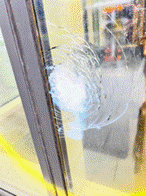
Only sheer luck prevented this incident from having far more serious, potentially tragic, consequences.
Such an incident can only reinforce the legitimate concerns already expressed by staff.
We do not need yet another rendition from the OIB Director — with no discernible variation between the former and the current incumbent — on the familiar “everything is fine, Madame la Marquise” refrain. We have heard that particular tune often enough to know it by heart.
Indeed, against this background, we trust that, on this occasion, staff representatives will not once again be met with statements from OIB management suggesting that they are artificially dramatizing security concerns, making irresponsible statements or creating an unjustified climate of fear among staff.
Regrettably, the persistence of this ostensibly reassuring narrative, which appears to convince virtually no one, is precisely what we may have reason to fear in the absence, to date, of any genuine change in attitude or internal procedures under the new Director of OIB. This is all the more disappointing given that we had understood that you had entrusted him with a clear mandate to introduce the necessary changes.
In any event, it is not for OIB to prejudge or dismiss such concerns. It is for the Commission to assess them properly, on the basis of the objective situation on the ground and in the light of the Institution’s duty to ensure appropriate conditions for the health, safety and security of its staff.
We wish, in this respect, to acknowledge the responsible approach taken by the management of the Executive Agencies concerned and their clear understanding of what their duty of care towards staff entails
By allowing the necessary flexibility in the organisation of work, they have sought, in particular, to avoid situations in which colleagues would be required to leave their offices late in the evening, when the perceived risks were considered to be greater.
Recent developments, however, call into question even that assumption. The municipality of Schaerbeek has itself acknowledged a deterioration in security conditions in the North District and, more recently, indicated that, while measures taken at night had made nights quieter, criminality, drug use and drug dealing had increasingly shifted to the daytime.
In these circumstances, everyone will be able to form their own view as to the merits of OIB’s approach of introducing structural measures concerning parking bikes facilities with a view to encouraging colleagues to make much greater use of bicycles for commuting to work.
OIB management: leading by example?
As the Mayor of Saint-Josse-ten-Noode recently put it, those who still doubt the seriousness of the situation in Brussels’ Northern Quarter should come and experience the reality on the ground for themselves, even if only for a short while.
As we already suggested at the time of the first relocation to the North District, we would therefore invite OIB management to consider relocating its own offices there and, naturally, commuting to work by bicycle. This would provide management with first-hand experience of the conditions faced every day by the colleagues affected by its decisions — while finally giving tangible meaning to the much-invoked principle of “leading by example”.
In return, such a fine example of “leading by example” would allow colleagues from the Executive Agencies, on a rotating basis, to enjoy OIB’s very attractive offices.
- 2. Financial considerations invoked to justify the relocation to the Northern Quarter versus the actual outcome of the sale of 23 buildings
In response to the questions raised regarding the justification for this further relocation to the Northern Quarter, the Commission stated that the move was driven by economic considerations and formed part of a particularly rigorous approach to the management of budgetary appropriations.
Sound and exemplary management of the Institution’s resources is undoubtedly essential. We fully recognise that the requirement to manage the budgetary resources entrusted to the Institution with the utmost care is particularly important in the context of the negotiations on the Multiannual Financial Framework and at a time when Member States themselves are facing significant budgetary constraints.
Precisely for that reason, however, before seeking additional savings by relocating Executive Agency staff to locations offering less favourable working conditions, the Commission should be able to demonstrate, on the basis of a transparent and verifiable assessment, the actual financial benefits already generated by its broader real-estate strategy, including the sale of the 23 Commission buildings.
That transaction was presented as a major rationalisation measure intended, inter alia, to generate substantial budgetary savings and to allow Commission services to be consolidated in a smaller number of buildings meeting higher standards.
Yet further savings are now said to be required, while the objective of consolidating Commission services within the same geographical area does not appear to be guaranteed.
This inevitably raises questions as to whether the financial benefits initially expected from the sale of the 23 buildings have fully materialised and, more generally, as to the overall financial impact of the Commission’s real-estate strategy.
In this respect, we fully share the critical assessment expressed by our colleagues from GEN 2004 regarding the need to ensure the highest possible degree of transparency and to provide complete information on the actual financial outcome of this sale.
Costs of “Usufruct for staying longer”
This is particularly difficult to reconcile with the very significant financial impact of the “Usufruct for staying longer” arrangement, which entails payments of €24.59 million in 2027 and a further €25.62 million in 2028 to cover the continued use of seven of the buildings sold (Draft General Budget of the EU 2027 – Working Document part VII, Commission Buildings)
Such very substantial unexpected additional costs inevitably raise legitimate questions as to whether the original planning assumptions, feasibility studies and risk assessments underpinning the transaction were sufficiently robust, and whether the financial consequences of the prolonged occupation of the buildings were properly identified, assessed and factored in from the outset.
Against that background, we would ask you to reassure us by confirming that, notwithstanding the very substantial amounts referred to above, there is no realistic scenario in which the purchaser could effectively recover the full acquisition price of the buildings solely through payments associated with the Commission’s continued use of the properties, without having had to carry out any renovation works or make any comparable investment in the buildings concerned.
It is essential that this possibility be unequivocally ruled out, as such a scenario would plainly be unacceptable.
More generally, staff and taxpayers are entitled to know whether the principles of sound financial management — economy, efficiency and effectiveness — were fully respected when decisions of this magnitude were taken.
This is a matter not only of transparency, but also of accountability.
These considerations are, by their very nature, political and go well beyond questions of management or the governance of an Office.
It is for that reason that we consider that these questions should be addressed to you, in your capacity as the Member of the Commission politically responsible for this matter, rather than to DG HR and, still less, to OIB.
This is all the more important given that it will ultimately be for you to respond to any questions that may be raised in this connection, including by the European Parliament, in particular in the context of the discharge procedure concerning our Institution.
The reputation and institutional credibility of the Commission are also at stake
The questions surrounding the sale procedure also have an obvious impact on the reputation and credibility of our Institution’s management, particularly in the context of the ongoing negotiations on the Multiannual Financial Framework.
It is self-evident that the sale of 23 Commission buildings constitutes one of the most significant internal financial transactions ever undertaken by our Institution. Colleagues have already expressed serious concerns about the potential reputational consequences of the questions surrounding the transaction and the impact these may have on the credibility of the Institution’s financial management.
These concerns go beyond the questions set out below regarding the actual financial benefit ultimately achieved. They also extend to the reservations that have been raised concerning the regularity and procedural soundness of the transaction.
Those concerns must, of course, be expressed with full respect for the presumption of innocence of any person concerned, due regard being had to the Commission’s assurances as to the regularity of the procedure, and without prejudging the outcome of any ongoing investigation, inquiry or audit.
At the same time, it cannot be ignored that the transaction has attracted scrutiny at the highest institutional level.
On the one hand, the European Court of Auditors in its 2024 Annual Report noted that the 23 buildings had been sold for €900 million, while the Commission retained rights of use over 17 of them for varying periods up to 2029. The Court further observed that only one bid had been received, that the bank guarantee submitted by the sole bidder did not comply with the original requirements laid down in the call for applications, and that the evaluation committee lacked sufficient independence because all its members were subordinate to the responsible authorising officer
On the other hand, these concerns were subsequently echoed by the European Parliament. In its decision on the Commission’s 2024 discharge, adopted on 29 April 2026, the European Parliament expressed serious concerns regarding the process surrounding the sale of the 23 buildings (link). In particular, Parliament referred to the apparent absence of clear impact assessments covering the transactions, the fact that only one bid had been received, issues concerning the bank guarantee submitted by the sole bidder and concerns regarding the independence of the evaluation committee.
It also referred to EPPO ongoing investigations in relation to the transaction and called on the Commission to provide the discharge authority with all relevant information and documentation concerning the sale, to disclose all relevant information and documentation, including the procedural steps followed, the evaluation methodology used and the assessment of the bid.
Taken together, the findings of the Court of Auditors and the Parliament’s discharge observations point to significant weaknesses in the management and oversight of a major real-estate transaction involving substantial amounts of EU funds.[1]
In this respect, we have duly noted that the Commission has maintained that the sale was conducted in accordance with the applicable procedures and has stated that it will cooperate fully with the investigators.
These are now matters of public record. Referring to them does not imply any conclusion as to the legality of the transaction or the responsibility of any individual.
It does, however, reinforce the need for complete transparency as regards both the procedure followed and the ultimate financial consequences of the transaction.
Conclusion
In these circumstances, we find it difficult to see how further relocations could be justified primarily on the basis of anticipated real-estate savings without first establishing, in a transparent, comprehensive and verifiable manner, the actual financial impact of previous real-estate decisions.
Such an assessment should also identify the full financial, operational and human consequences of any proposed relocation of Executive Agency staff.
Therefore, the relevant issue is no longer how the Institution can further extend its presence in the North District but, quite the contrary, how the substantial savings promised — notably through the sale of the 23 buildings — should now be used to bring colleagues already working there back into closer geographical proximity with the rest of the Commission’s staff.
And if, for whatever reason, the anticipated savings have not ultimately materialised, the very first requirement must be full transparency and accountability as to why this has happened.
In any event, it would be wholly unacceptable for colleagues in the Executive Agencies to be made to bear the consequences.
They cannot be treated as an adjustment variable for shortcomings in financial planning, nor should their safety, working conditions and equal treatment be compromised in order to absorb costs or compensate for savings that failed to materialise elsewhere.
Cristiano Sebastiani,
Chair
Copy:
Mr Bjoern SEIBERT, Head of Cabinet of President von der Leyen
Mr Grzegorz RADZIEJEWSKI, Head of Cabinet Serafin; Ms Ana CARRERO YUBERO, Member of Cabinet Serafin
Mr Stephen QUEST, Director-General; Mr Christian ROQUES, Deputy Director-General; Mr Christian Linder, Director F;
Mr Laurent Duluc, Deputy head of Unit HR. F.4; DG HR
Mr Morten FJALLAND, OIB Director; Mr Carlo CHEMALY, Head of Unit OIB RPP.3 , SIPP
Ms Paloma ABA GARROTE, CINEA Director
Ms Sophie BEERNAERS, EACEA Director
Mr Momchil SABEV, EISMEA Director
Ms Laurence MOREAU, ERCEA Director
Mr Marc TACHELET, HaDEA Director
Mr Stephen COLLINS, REA Director
Staff
[1] European Court of Auditors, Annual reports on the implementation of the EU budget for the 2024 financial year, Chapter 10, “European public administration”, para. 10.18; European Parliament resolution of 29 April 2026 with observations forming an integral part of the decisions on discharge in respect of the implementation of the general budget of the European Union for the financial year 2024, Section III – Commission and executive agencies, P10_TA(2026)0125, paras. 231 and 249(i)–(iii).