Brussels, 19 December 2025
Note to the attention of Mr. Piotr Serafin
Commissioner for Budget, Anti Fraud and Public Administration
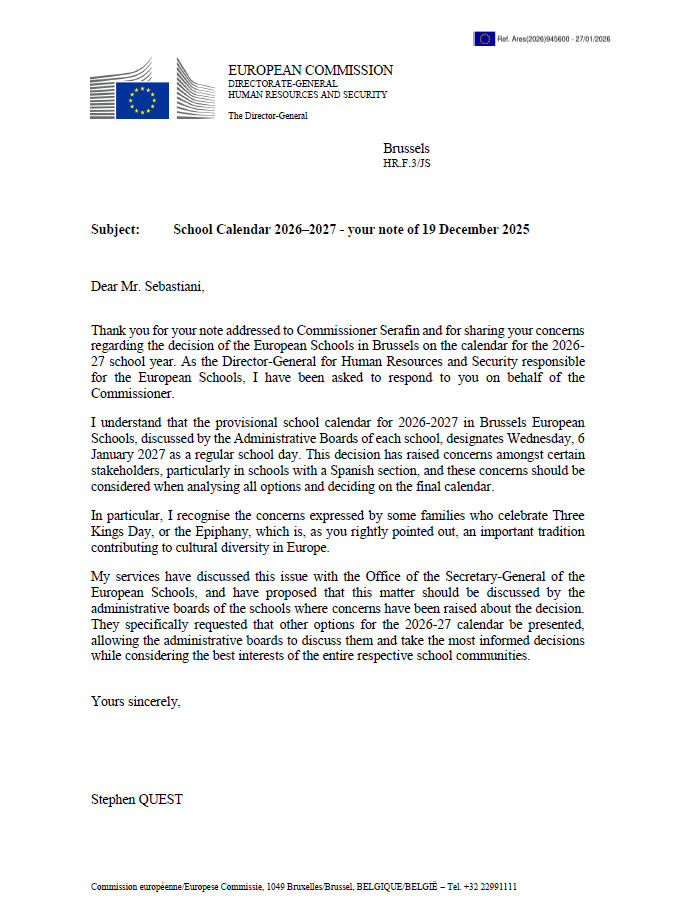
Subject: School Calendar 2026–2027: A Troubling Decision for Cultural Diversity
Dear Commissioner Serafin,
As the European Schools have now published the calendar for the academic year 2026 – 2027, families are deeply concerned and profoundly disappointed to note that 4, 5 and 6 January 2027 have been designated as school days. This decision fails to respect and recognize the cultural and family traditions of several EU countries, where the festivities of 6 January hold profound significance.
In many European countries, this celebration is not merely a symbolic tradition. It is a cherished cultural, religious, and family event, marked by gatherings, community festivities, and rituals passed down for generations. For children and families alike, this day represents one of the most important moments of the year. To deprive families of the opportunity to participate fully in these traditions not only undermines but disregards a vital part of Europe’s cultural fabric.
What is particularly troubling is that this outcome appears unnecessary. The consultation process was intended to explore viable alternatives, and solutions were indeed proposed – such as adopting models successfully used in previous years, including the 2020–2021 calendar. These models ensured educational continuity while respecting essential traditions. Yet such alternatives were dismissed without satisfactory explanation, leaving stakeholders with the impression that input was solicited but not genuinely considered.
The disparity between Brussels European Schools and other schools in the European School system further exacerbates the issue. While families in other European Schools benefit from holidays extending until 7 January, those in Brussels are asked to return earlier, creating a clear sense of unequal treatment and disregard for community concerns. Such inconsistency not only damages trust but also contradicts the system’s commitment to fairness and unity.
While Renouveau et Démocratie appreciates the recognition of multicultural richness within the Brussels classroom by the Secretariat General of the European Schools, this sort of argument misses the essence of the concern. Traditions of such importance are not limited to symbolic activities or classroom exercises. They are lived through family gatherings, community events, and shared experiences that extend well beyond the school walls. Suggesting that children can simply celebrate at home before or after school reduces these traditions to a token gesture, stripping them of their depth and meaning.
Moreover, the idea that festivities can be compressed into the early morning or late evening hours ignores the reality of how these celebrations unfold: they are collective, immersive, and time‑intensive, involving parades, family meals, and community participation. To expect children to attend school on these days is to deprive them of the full experience, and risks turning a cornerstone of cultural identity into a hurried ritual. Respecting multicultural traditions means allowing families the time to live them authentically, not merely acknowledging them in passing. A calendar that disregards this undermines the very diversity the European Schools claim to uphold.
Adding to this concern, the 2026 – 2027 calendar foresees an unusually early end to the school year: classes will finish as early as 2 July 2027, earlier than normal.
This raises further questions about the rationale behind the calendar’s design, as it seems to compress the school year at both ends, without clear educational justification, while operating at the expense of cultural respect and family balance.
Families are left wondering whether such decisions are being driven not by pedagogical priorities, but by administrative cost‑reduction measures in school operations. If so, this would represent a serious departure from the mission of the European Schools, where educational and cultural needs must come before financial expediency. Cultural diversity is a cornerstone of the European Schools. It must be respected in practice, not only in principle.
To finalize the calendar despite strong and sustained opposition sends a troubling message: that the voices of diverse communities across Europe are not being adequately heard and that the values the institution claims to uphold are not being actively protected.
As the festive season approaches, we cannot help but wish for calendars as clear as Christmas lights and for a New Year where Europe’s rich cultural diversity shines as brightly as its traditions. May the 2026 – 2027 European Schools Brussels calendar bring not confusion in dates, but harmony in diversity – because nothing says “Happy New Year” like a calendar that truly reflects the values of our European family.
With festive greetings and best wishes,
Cristiano Sebastiani
President of Renouveau et Démocratie
Copy:
Mr Andreas Beckmann, Secretary-General of the European Schools
Directors of European Schools
APEEE
Mr S. Quest, Director-General; Mr C. Linder, Director HR.F; Mr L. Duluc, Deputy Head of Unit, HR
Staff